'%3e%3cpath%20d='M34.1406%205.85938C30.3906%202.10547%2025.3047%200%2020%200C14.6953%200%209.60938%202.10547%205.85938%205.85938C2.10938%209.61328%200%2014.6953%200%2020C0%2025.3047%202.10547%2030.3906%205.85938%2034.1406C9.61328%2037.8906%2014.6953%2040%2020%2040C25.3047%2040%2030.3906%2037.8945%2034.1406%2034.1406C37.8906%2030.3906%2040%2025.3047%2040%2020C40%2014.6953%2037.8945%209.60938%2034.1406%205.85938ZM37.0117%2023.543H31.1602V13.5391H27.6328V19.9414C28.1211%2020.6914%2028.3711%2021.582%2028.3711%2022.5625V22.625C28.3711%2023.668%2028.1172%2024.6055%2027.6328%2025.4297V26.6094H36.082C33.4883%2032.9375%2027.2891%2037.3789%2020.0039%2037.3789C10.3711%2037.3789%202.62109%2029.6289%202.62109%2020C2.62109%2010.3711%2010.3711%202.62109%2020%202.62109C29.6289%202.62109%2037.3789%2010.3711%2037.3789%2020C37.3789%2021.1484%2037.2617%2022.2656%2037.0508%2023.3477C37.0391%2023.4141%2037.0234%2023.4766%2037.0117%2023.543Z'%20fill='white'/%3e%3cpath%20d='M22.3086%2018.5352C20.4336%2018.125%2019.9531%2017.8398%2019.9766%2017.1836V17.1406C19.9766%2016.6992%2020.3477%2016.2148%2021.4023%2016.2148C22.582%2016.2148%2023.8867%2016.6797%2025.0781%2017.4766L26.8516%2015.0195C25.4453%2013.8906%2023.707%2013.3398%2021.5547%2013.3398C18.5195%2013.3398%2016.4375%2015%2016.4063%2017.4766V17.5352C16.3633%2020.2617%2018.5859%2020.9805%2021.293%2021.6016C23.0391%2021.9766%2023.5703%2022.3164%2023.5703%2022.9609L23.5469%2022.9766C23.5469%2023.3906%2023.2578%2023.7031%2022.7852%2023.8359C22.5742%2023.9062%2022.1289%2023.9727%2021.5156%2023.9727C20.7617%2023.9727%2019.7539%2023.8633%2018.6328%2023.4844C18.0898%2023.2891%2017.4727%2023.0039%2016.8047%2022.6133L20.1406%2026.625C20.2813%2026.6602%2021.0977%2026.8516%2021.7734%2026.8516C25.0039%2026.8516%2027.0859%2025.2461%2027.1094%2022.6328V22.5703C27.1602%2020.1133%2025.2148%2019.1719%2022.3086%2018.5352Z'%20fill='white'/%3e%3cpath%20d='M5.24219%2013.5664V26.6133H8.75391V23.7578L10.2969%2021.9531L14.2031%2026.6133H18.3867L12.3555%2019.5195L17.4023%2013.5664H13.4531L8.75391%2019.0586V13.5664H5.24219Z'%20fill='white'/%3e%3c/g%3e%3cdefs%3e%3cclipPath%20id='clip0_97_2430'%3e%3crect%20width='40'%20height='40'%20fill='white'/%3e%3c/clipPath%3e%3c/defs%3e%3c/svg%3e)




Estimated read time: 6-7 minutes
This archived news story is available only for your personal, non-commercial use. Information in the story may be outdated or superseded by additional information. Reading or replaying the story in its archived form does not constitute a republication of the story.
SALT LAKE CITY — Providing humanitarian aid, imposing sanctions, seizing Russian-owned property, even enacting a no-fly zone, have all made the short list of ways the U.S. should respond to the ongoing war in Ukraine.
Now, a new Deseret News/Hinckley Institute of Politics poll gives new insight into what Utah voters think, and shows they are closely watching the situation.
Providing humanitarian assistance and weapons are the most popular responses among Utahns — 73% say the U.S. should continue providing aid to Ukraine, and 68% support sending military aid, according to the survey.
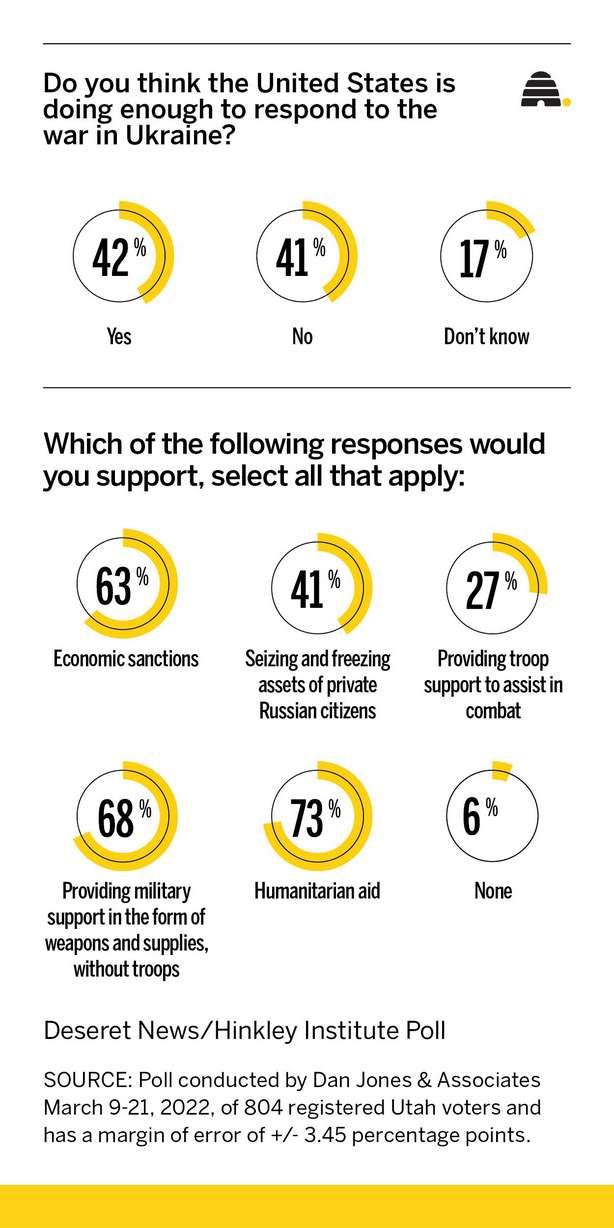
Dan Jones & Associates conducted the poll of 804 registered Utah voters from March 9-21. It has a margin of error of plus or minus 3.45 percentage points.
The Biden administration recently announced it will funnel $1 billion to Ukraine and neighboring countries for humanitarian aid, including money for food, medical supplies, hygiene kits and assisting groups like the U.N., World Food Programme and other non-governmental organizations.
Since the invasion began on Feb. 24 over 3.7 million refugees have fled Ukraine, most of them now in Poland, according to the U.N. Estimates vary, but there are likely an additional 6.5 million internally displaced Ukrainians.
"Whether it's food, a blanket, cash or care from medical teams that we send in, or child welfare specialists, they need it now," President Joe Biden said, touting the announcement during a joint briefing with Polish President Andrzej Duda on Friday as he visits Eastern Europe.
Since Russia's annexation of Crimea in 2014, the U.S. has sent billions in military assistance to Ukraine. Funding ramped up in the days since Russian troops invaded, with the U.S. sending anti-aircraft and anti-tank missile systems, guns, body armor, helmets and vehicles.
The Biden administration also imposed sanctions on Russia, including banning Russian flights, exports on luxury goods and military equipment. Sanctions aimed at the Russian central bank froze hundreds of billions of dollars of assets, while the Russian ruble has lost nearly half of its value since the invasion began.
Roughly 63% of poll respondents said they support continued economic sanctions. And 41% said the U.S. should target and freeze assets of Russian citizens, a tactic deployed by the European Union which recently seized several superyachts owned by Russian oligarchs.
Is the U.S. doing enough to help Ukrainians?
After weeks of headlines detailing increased humanitarian aid, economic sanctions and shipments of military supplies, there's division among Utah voters on whether those efforts are sufficient.
Around 42% said the government is doing enough, while 41% said it isn't. The rest said they don't know.
That divide could be the result of partisanship, with some conservative politicians and pundits arguing the invasion would have never happened under former President Donald Trump's watch. Around 58% of Democrat respondents said the U.S. was doing enough, compared to just 36% of Republicans.
That partisanship was on display before the invasion even began, says University of Utah political science professor Matthew Burbank, who pointed out the division among Republicans and Democrats in Congress over when exactly to impose sanctions on Russia.
As Russian troops amassed on the border, "there was a debate about should we use sanctions right away, or should we use sanctions as a deterrent and if he invades we can apply them," Burbank said.
"Republicans argued for putting the sanctions in right away and Democrats said let's wait and use them as a deterrent," he said.
Whether it was preemptive sanctions in the days leading up to the invasion or humanitarian and military aid a month later, Burbank says "partisanship can play into (public opinion), even if the real substantive differences aren't all that different."
Some in the think tank world point to the difference U.S. military aid has already had on Ukraine fending off the Russians in Kyiv as an argument for more "offensive" weapons.
"The aid that the United States and the West has given Ukrainians has made a telling difference. But the kinds of things that we've given them are inherently defensive," said Giselle Donnelly, senior fellow at the American Enterprise Institute, speaking to Boyd Matheson on KSL's "Inside Sources."
Donnelly said Ukraine's strategic advantage will play a key role in any future ceasefire negotiations. If Russia still holds large swaths of territory, she says that could hinder Ukraine's bargaining power.
"That means they need some counter-offensive ground-gaining and ground-holding capacity beyond what they currently have, and they need it quickly," Donnelly said.
Sending troops to Europe
Most respondents in the Deseret News/Hinckley Institute poll stopped short at throwing their support behind sending U.S. forces to fight, a move countless editorial boards, activists and politicians, including Biden, say could lead to unimaginable consequences.
As U.N. secretary general António Guterres put it, "The prospect of nuclear conflict, once unthinkable, is now back within the realm of possibility."
Still, 27% of Utahns said they would support the U.S. providing troops to assist in combat.
Age is the biggest indicator in the poll, with 36% of respondents between 18 to 24 years old saying the U.S. should deploy its military.
That surprised Burbank, the political science professor.
Young people are more likely to be the "troops" referred to in the poll question. Plus 20 years of war in Afghanistan followed by America's chaotic withdrawal in August galvanized an anti-intervention sentiment among millennials and generation Z, he said.
What it boils down to, Burbank said, are lived experiences. The question of sending troops overseas loses popularity the older the respondents in the survey get, the lowest being Utahns over age 57 at 23%.
"They think of the Soviet Union and all the years of the Cold War. There's a sense that if you get involved with Russia, it's very likely nuclear war," he said. "I think you might have some kind of generational difference there."

The shocking news reports of the violence in Ukraine is catching the attention of Utahns. The poll found 85% say they are following the invasion closely, with 38% saying "very closely" and 47% "somewhat closely."
Utahns' interest has turned into widespread solidarity, on display Monday during the Voices for Ukraine event in downtown Salt Lake City, where hundreds of people came out to watch musical performances, dancers and speakers in an effort to raise funds for Ukrainian refugees.
Utah Gov. Spencer Cox and first lady Abby Cox were in the crowd, which spilled over into the aisles and into the standing room area in the back of the cathedral halls.