'%3e%3cpath%20d='M34.1406%205.85938C30.3906%202.10547%2025.3047%200%2020%200C14.6953%200%209.60938%202.10547%205.85938%205.85938C2.10938%209.61328%200%2014.6953%200%2020C0%2025.3047%202.10547%2030.3906%205.85938%2034.1406C9.61328%2037.8906%2014.6953%2040%2020%2040C25.3047%2040%2030.3906%2037.8945%2034.1406%2034.1406C37.8906%2030.3906%2040%2025.3047%2040%2020C40%2014.6953%2037.8945%209.60938%2034.1406%205.85938ZM37.0117%2023.543H31.1602V13.5391H27.6328V19.9414C28.1211%2020.6914%2028.3711%2021.582%2028.3711%2022.5625V22.625C28.3711%2023.668%2028.1172%2024.6055%2027.6328%2025.4297V26.6094H36.082C33.4883%2032.9375%2027.2891%2037.3789%2020.0039%2037.3789C10.3711%2037.3789%202.62109%2029.6289%202.62109%2020C2.62109%2010.3711%2010.3711%202.62109%2020%202.62109C29.6289%202.62109%2037.3789%2010.3711%2037.3789%2020C37.3789%2021.1484%2037.2617%2022.2656%2037.0508%2023.3477C37.0391%2023.4141%2037.0234%2023.4766%2037.0117%2023.543Z'%20fill='white'/%3e%3cpath%20d='M22.3086%2018.5352C20.4336%2018.125%2019.9531%2017.8398%2019.9766%2017.1836V17.1406C19.9766%2016.6992%2020.3477%2016.2148%2021.4023%2016.2148C22.582%2016.2148%2023.8867%2016.6797%2025.0781%2017.4766L26.8516%2015.0195C25.4453%2013.8906%2023.707%2013.3398%2021.5547%2013.3398C18.5195%2013.3398%2016.4375%2015%2016.4063%2017.4766V17.5352C16.3633%2020.2617%2018.5859%2020.9805%2021.293%2021.6016C23.0391%2021.9766%2023.5703%2022.3164%2023.5703%2022.9609L23.5469%2022.9766C23.5469%2023.3906%2023.2578%2023.7031%2022.7852%2023.8359C22.5742%2023.9062%2022.1289%2023.9727%2021.5156%2023.9727C20.7617%2023.9727%2019.7539%2023.8633%2018.6328%2023.4844C18.0898%2023.2891%2017.4727%2023.0039%2016.8047%2022.6133L20.1406%2026.625C20.2813%2026.6602%2021.0977%2026.8516%2021.7734%2026.8516C25.0039%2026.8516%2027.0859%2025.2461%2027.1094%2022.6328V22.5703C27.1602%2020.1133%2025.2148%2019.1719%2022.3086%2018.5352Z'%20fill='white'/%3e%3cpath%20d='M5.24219%2013.5664V26.6133H8.75391V23.7578L10.2969%2021.9531L14.2031%2026.6133H18.3867L12.3555%2019.5195L17.4023%2013.5664H13.4531L8.75391%2019.0586V13.5664H5.24219Z'%20fill='white'/%3e%3c/g%3e%3cdefs%3e%3cclipPath%20id='clip0_97_2430'%3e%3crect%20width='40'%20height='40'%20fill='white'/%3e%3c/clipPath%3e%3c/defs%3e%3c/svg%3e)


- Representatives from Utah's eight tribal groups and state officials met at Utah Valley University for three days of meetings.
- Among the concerns of tribal leaders at the Native American Summit were water availability and economic development.
- Public panel discussions Friday focused on higher education housing, economic development and more.
OREM — Leaders of Utah's eight tribal groups converged on Orem this week to meet with Utah state officials as part of an annual gathering meant to give the Native American officials an opportunity to air their needs and priorities.
The meetings at Utah Valley University, most of them on Wednesday and Thursday, weren't open to the public. But Dustin Jansen, director of Utah's Division of Indian Affairs, said Friday, the last day of the Native American Summit, that at least a few issues emerged as key concerns among the tribal officials, including availability of water and economic development.
"I think for every tribe, water's an issue. It's a shared issue with the states," he said. "Where's our water going to go? What should our water go to? Where should it be? How do we use it?"
Every western U.S. state is worried about how to parse out dwindling water supplies, he said, but every Indian tribe in the West is similarly concerned.
Jansen said economic development is another area of focus for Utah's tribes. Representatives from an array of Utah state departments were on hand to meet with the tribal officials.
"The tribes are always interested in boosting that within their communities and finding a diversity of ways to ... give their economy a boost," he said.
While specific concerns may have emerged at the summit, Jansen stressed the importance of the event, now in its 20th year, as a means of promoting good relations between tribal governments and the state government. Some in the public, he noted, think of Native Americans simply as a minority group.
"But these are actual governments. They have a government-to-government relationship with the federal government. But they also want to have that relationship with the state, and the state wants that, too," Jansen said. The summit "gives state agencies and tribes an opportunity to get together, make some appointments for future meetings to address issues in those communities."
Utah Valley University has been the host site for the summit in recent years. Justin Allison, the UVU director of native excellence and tribal engagement, welcomes the gathering as a way to highlight the Native American programming at the school. "We like to host it because we want (UVU) to be ... the center for anything Native American," he said.
The federally recognized Native American groups in Utah include the Confederated Tribes of Goshute, the Skull Valley Band of Goshute, the Paiute Indian Tribe and the San Juan Southern Paiute Tribe. The Navajo Nation, the Ute Indian Tribe, the Northwestern Band of Shoshone Nation and the White Mesa Community of the Ute Mountain Ute Tribe round out the eight.
Higher education, economic development
Though the meetings between tribal and Utah leaders weren't open, several public panel discussions on issues of import to the Native American community were held on Friday. The topics ranged from preserving Indigenous languages and higher education to housing and economic development, among other things.
In a discussion on higher education, Mike Nelson stressed the importance, at least in his own case, of having a support network for Native American students. He's director of student belonging, student engagement and leadership at Utah Tech University in St. George, which he attended when it was known as Dixie State University.
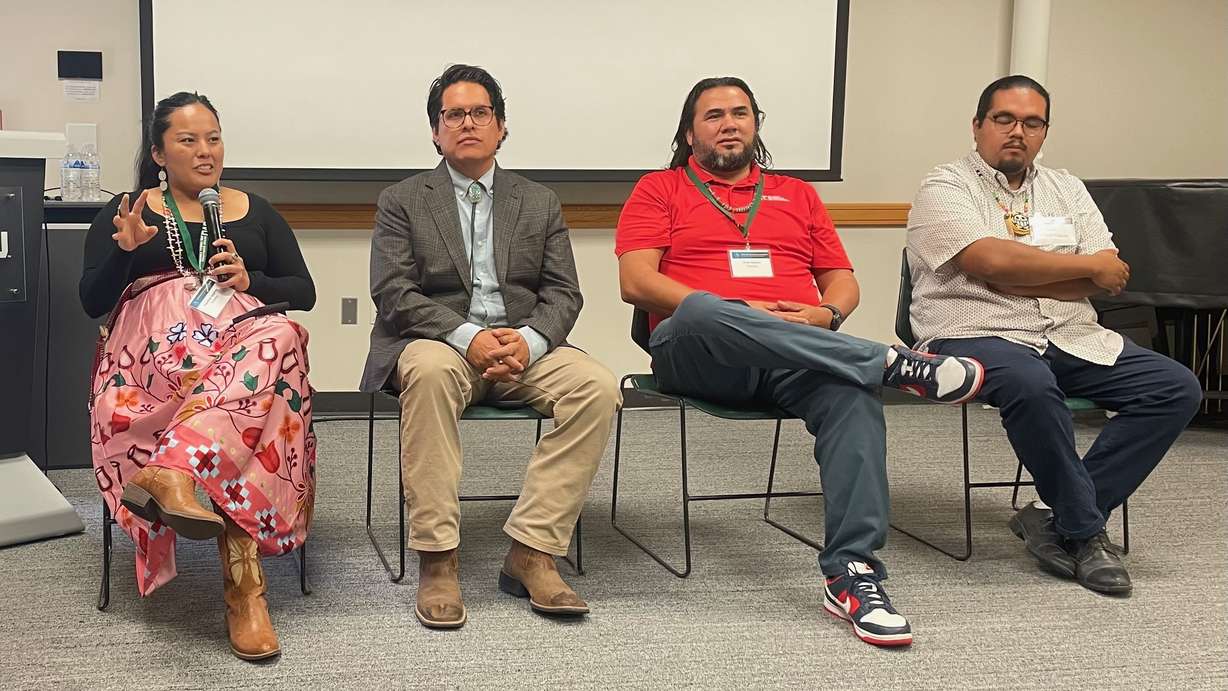
He had enrolled in the college, soon dropped out, then returned 12 years later, finding a much more supportive atmosphere given the presence at the time of a multicultural center. "When I returned, I had people that looked like me, talked like me, that understand my experience. So I found a lot of identification and support from there," he said.
Allison, the UVU official, spoke of the importance of addressing the worries of parents of Native American students attending the university and helping them navigate the process. Some Native American students come from reservations or are leaving home for the first time.
Having Native American representatives at the university who understand the culture "really helped calm some of the fears that our parents did have and it encouraged parents to kind of trust us in that process as their student is on their journey to education," he said.
Faustine Saganey, program coordinator at Utah State University's Center for Community, hopes for gradual increases in university attendance among successive generations of Native American students.
"It's going to keep progressing and progressing over time, and eventually we'll have a whole room full of students, full of lawyers, full of doctors, nurses, engineers, and that's what success looks like to me," she said. "One day we can bring them all back home to the reservations that they are from."
In a panel discussion on economic development in tribal communities, the varied presenters stressed the opportunities connected to the 2034 Winter Olympics, which Utah will host.
Read more:
Multicultural Utah
Looking for more news about the different cultures that call Utah home? Visit our Multicultural Utah section for more stories, events and features.Chandler Chavis, an entrepreneur, suggested holding a "unity powwow" before the Olympic Games start.
"That allows vendors, that allows the world to see Utah not only just for the state, but the people that were here before Utah was a state and the tribes that were here before," he said.
He also encouraged business operators to start looking for opportunities now to fill the needs created by the coming of the Olympics. "There is a lot of money already moving around right now. Contracts are going to be happening fast," he said.

Most recent Utah stories
Related topics
 Tim Vandenack