- A new poll from the Deseret News and the Hinckley Institute of Politics shows Utahns' views on deportation align with national opinions.
- Fifty percent of Utahns support deporting undocumented immigrants; national support is 48%.
- Latter-day Saint voters were much more supportive of strict deportation policies than Utah and national averages.
SALT LAKE CITY — Utah has long been an outlier among red states on immigration issues. A new poll from the Deseret News and the Hinckley Institute of Politics suggests that distinction may be fading — especially when voters are broken down by gender and religion.
Americans are evenly split when it comes to deporting an immigrant living in the country illegally who has not otherwise committed a crime. And Utah mirrors the national polling numbers.
Immigration has been a flashpoint for decades. Since President Donald Trump took office for the second time in early 2025, tensions over immigration have heightened, particularly over how his deportation policies have been enforced.

Pew Research Center counted 53.3 million immigrants living in the U.S. in January 2025 — the largest number ever recorded. A quarter of those, or around 14 million, were considered unauthorized. A year later, The New York Times reported that 540,000 deportations had taken place since President Donald Trump took office again.
Amid an historic surge in immigration during the four years of the Biden administration, 775,000 unauthorized migrants were removed from May 11, 2023, to Jan. 20, 2025, when Donald Trump took office. Similarly, the Obama Administration saw 1.5 million formal removals from 2013 to 2016.
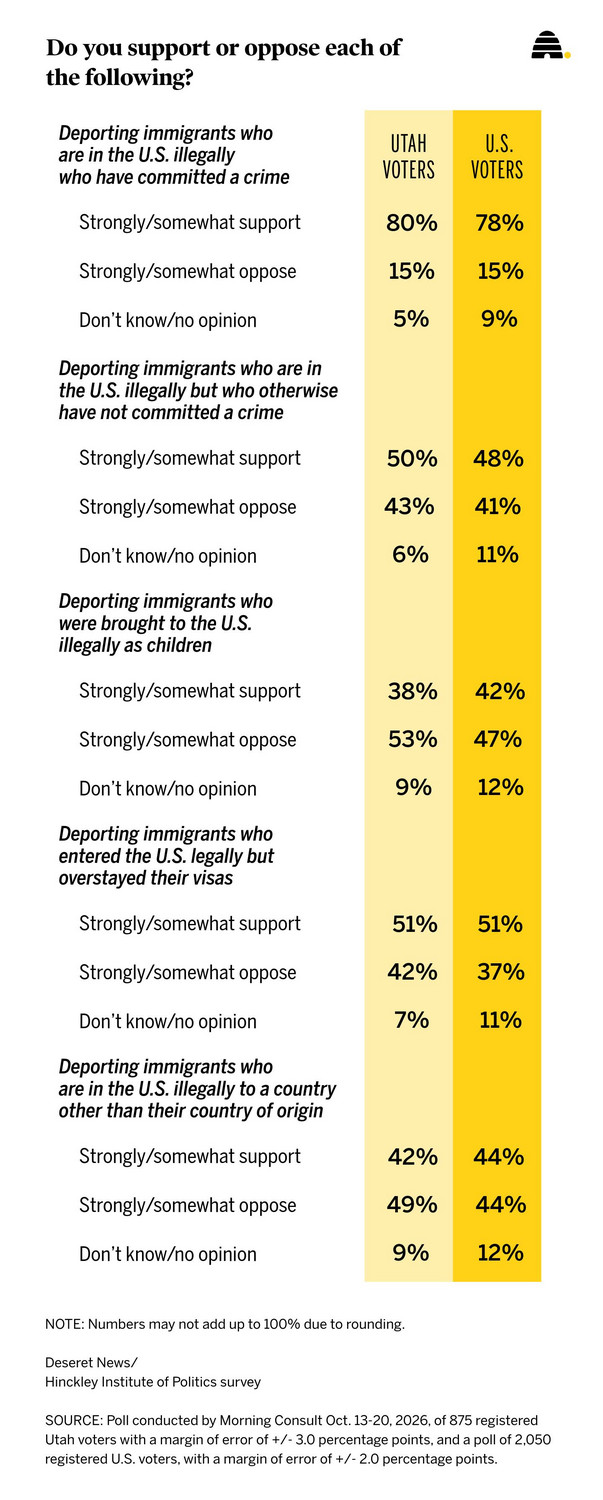
The Deseret News/Hinckley Institute of Politics poll, conducted by Morning Consult, found that 50% of Utahns support deporting an immigrant living in the country illegally, compared to 48% nationally — a negligible difference. If an immigrant has committed a crime in the United States, the support for deportations jumps to roughly 80% in both the Utah and the national poll.
While similar to the U.S., when Utah poll results are broken into more specific demographics, there is a clear partisan split, as well as a divide between men and women and Latter-day Saint voters and the general population.
The female divide
The poll found that when asked about deporting immigrants living in the country illegally who have otherwise committed no crimes, 75% of Republican men were in support, while 66% of Republican women were in support.
The trend line continues across political lines. For the same question, 38% of Democratic men were in support, while only 16% of Democratic women were in support.
"This doesn't really surprise me," said Susan Madsen, founding director of the Utah Women & Leadership Project at Utah State University.
Madsen said women tend to "see the value in safety nets" — in not leaning too wholeheartedly into an issue. As women are often caretakers and homemakers, Madsen argued they see the immigration issue specifically from a unique, empathetic standpoint.
When asked about deporting immigrants to another country other than their country of origin, 65% of Republican men supported it, compared with only 42% of Republican women. Similarly, when asked about deporting immigrants who were brought to the U.S. illegally as children, 63% of Republican men supported it, while only 39% of Republican women were in support.
Referring to a study from the University of Colorado, Madsen said that women in leadership tend to allocate budget spending on education and healthcare more than men. A similar study found that healthcare spending for poor children, disabled people and elderly people was more generous in all 50 states, regardless of party, when women held a substantial number of seats.
But not everyone sees the gender divide as something so black and white.
"What I see here is a pretty consistent difference in the way that women and men view the rule of law," said Carolyn Phippen, president of the Women's Republican Club of Salt Lake. "Accountability and the rule of law is extremely important for a functioning nation and society."
Phippen agreed that women are often much more compassionate by nature and men are much more analytical, but argued that "you can't have one without the other."
"If you take a look, every time compassion rules a policy, you end up with the most vulnerable in society suffering even more, because you can't have priority placed on compassion and expect great results," she said.
Phippen said the public, at the very least, expects its elected officials to follow through with the laws passed regarding immigration.
The Latter-day Saint divide

The Deseret News poll also found that for some poll questions, Latter-day Saint voters were much more supportive of strict deportation policies than Utah and national averages.
When asked about deporting immigrants who are in the U.S. illegally and who have committed a crime, Latter-day Saint Utahns were more supportive of deportations than the national average by 10 percentage points. Similarly, when asked about immigrants who entered the U.S. illegally and who otherwise have committed no crimes, Latter-day Saint Utahns were more supportive of deportations by 15 percentage points.
There is a +/- 4.6 percentage point margin of error for the Latter-day Saint polling.
In 2010, the church issued an official statement supporting principles of the Utah Compact, which calls for a balanced approach to immigration policy, saying that "Public officials should create and administer laws that reflect the best of our aspirations as a just and caring society."
David Campbell, a professor at the University of Notre Dame and author of "Seeking the Promised Land: Mormons and American Politics," said the findings aren't necessarily surprising, but are part of a larger trend.
"It is true that in general we have found — myself, but others as well — in general LDS voters have been more moderate on immigration," he started. "But all of that data was collected pre-this current era of immigration, where it has become a highly salient issue. It has become really the central issue within the contemporary Republican Party."
Campbell called party-favoring one of the big themes in the study of religion and politics. What he and other researchers have found is a growing trend of political affiliations influencing religious beliefs — not the other way around.
"It's the political attitudes that then shape how you interpret your own religion's doctrines," he said.
Emma Petty Addams, co-executive director of Mormon Women for Ethical Government, said, "It is perplexing to us to see (immigration) become such a political issue because we feel like it should supersede politics."
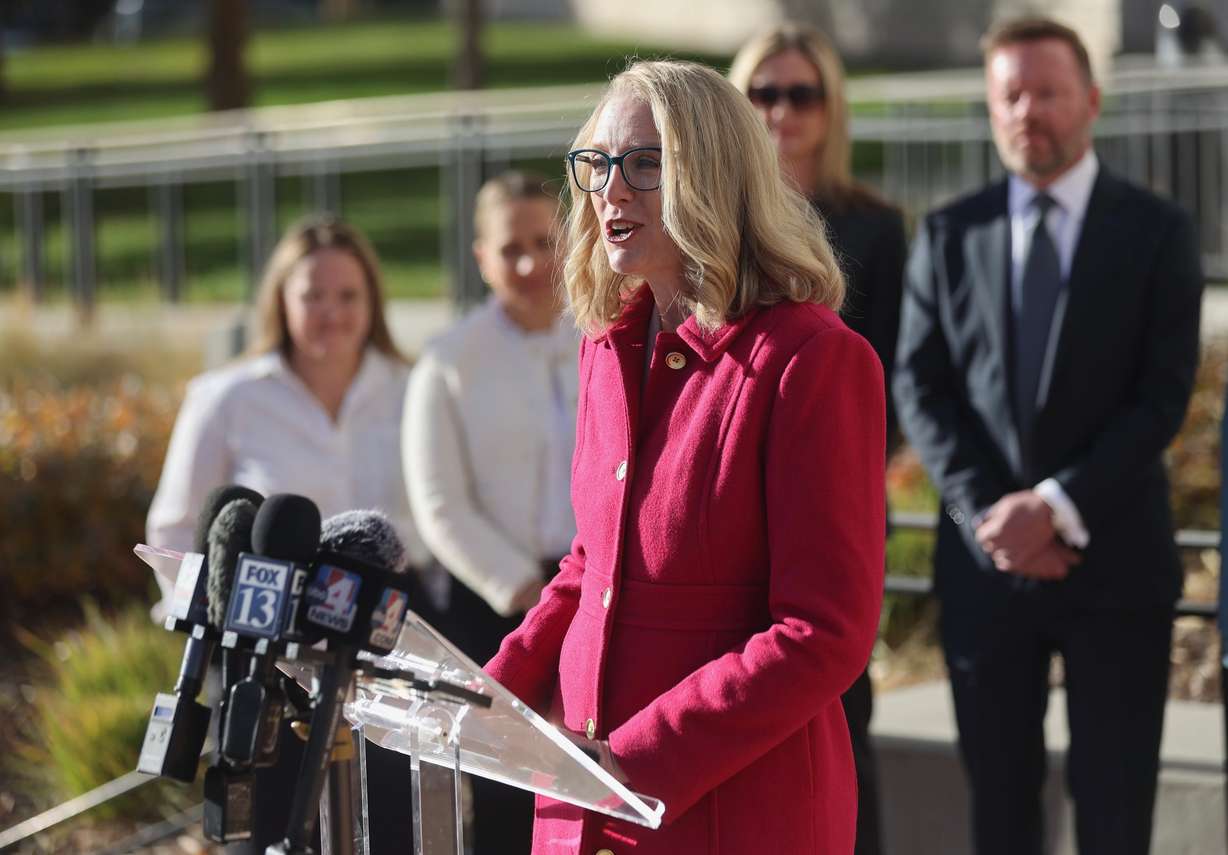
Addams said as she and the MWEG organization have grappled with the highly partisan issue, they have dismissed the idea of "justice versus compassion."
"So either you are for just laws and following the law, or you are for compassion," she said. "And we reject the notion that those two are binary."