'%3e%3cpath%20d='M34.1406%205.85938C30.3906%202.10547%2025.3047%200%2020%200C14.6953%200%209.60938%202.10547%205.85938%205.85938C2.10938%209.61328%200%2014.6953%200%2020C0%2025.3047%202.10547%2030.3906%205.85938%2034.1406C9.61328%2037.8906%2014.6953%2040%2020%2040C25.3047%2040%2030.3906%2037.8945%2034.1406%2034.1406C37.8906%2030.3906%2040%2025.3047%2040%2020C40%2014.6953%2037.8945%209.60938%2034.1406%205.85938ZM37.0117%2023.543H31.1602V13.5391H27.6328V19.9414C28.1211%2020.6914%2028.3711%2021.582%2028.3711%2022.5625V22.625C28.3711%2023.668%2028.1172%2024.6055%2027.6328%2025.4297V26.6094H36.082C33.4883%2032.9375%2027.2891%2037.3789%2020.0039%2037.3789C10.3711%2037.3789%202.62109%2029.6289%202.62109%2020C2.62109%2010.3711%2010.3711%202.62109%2020%202.62109C29.6289%202.62109%2037.3789%2010.3711%2037.3789%2020C37.3789%2021.1484%2037.2617%2022.2656%2037.0508%2023.3477C37.0391%2023.4141%2037.0234%2023.4766%2037.0117%2023.543Z'%20fill='white'/%3e%3cpath%20d='M22.3086%2018.5352C20.4336%2018.125%2019.9531%2017.8398%2019.9766%2017.1836V17.1406C19.9766%2016.6992%2020.3477%2016.2148%2021.4023%2016.2148C22.582%2016.2148%2023.8867%2016.6797%2025.0781%2017.4766L26.8516%2015.0195C25.4453%2013.8906%2023.707%2013.3398%2021.5547%2013.3398C18.5195%2013.3398%2016.4375%2015%2016.4063%2017.4766V17.5352C16.3633%2020.2617%2018.5859%2020.9805%2021.293%2021.6016C23.0391%2021.9766%2023.5703%2022.3164%2023.5703%2022.9609L23.5469%2022.9766C23.5469%2023.3906%2023.2578%2023.7031%2022.7852%2023.8359C22.5742%2023.9062%2022.1289%2023.9727%2021.5156%2023.9727C20.7617%2023.9727%2019.7539%2023.8633%2018.6328%2023.4844C18.0898%2023.2891%2017.4727%2023.0039%2016.8047%2022.6133L20.1406%2026.625C20.2813%2026.6602%2021.0977%2026.8516%2021.7734%2026.8516C25.0039%2026.8516%2027.0859%2025.2461%2027.1094%2022.6328V22.5703C27.1602%2020.1133%2025.2148%2019.1719%2022.3086%2018.5352Z'%20fill='white'/%3e%3cpath%20d='M5.24219%2013.5664V26.6133H8.75391V23.7578L10.2969%2021.9531L14.2031%2026.6133H18.3867L12.3555%2019.5195L17.4023%2013.5664H13.4531L8.75391%2019.0586V13.5664H5.24219Z'%20fill='white'/%3e%3c/g%3e%3cdefs%3e%3cclipPath%20id='clip0_97_2430'%3e%3crect%20width='40'%20height='40'%20fill='white'/%3e%3c/clipPath%3e%3c/defs%3e%3c/svg%3e)


- Holocaust survivor Sora Vigorito shared her story at the University of Utah.
- She recounted surviving Mengele's experiments and losing her twin sister at Auschwitz.
- Vigorito emphasized her mission to share experiences and inspire resilience and faith.
SALT LAKE CITY — The youngest known survivor of Josef Mengele's twin experiments spoke at the University of Utah, to one of the largest crowds she had ever addressed.
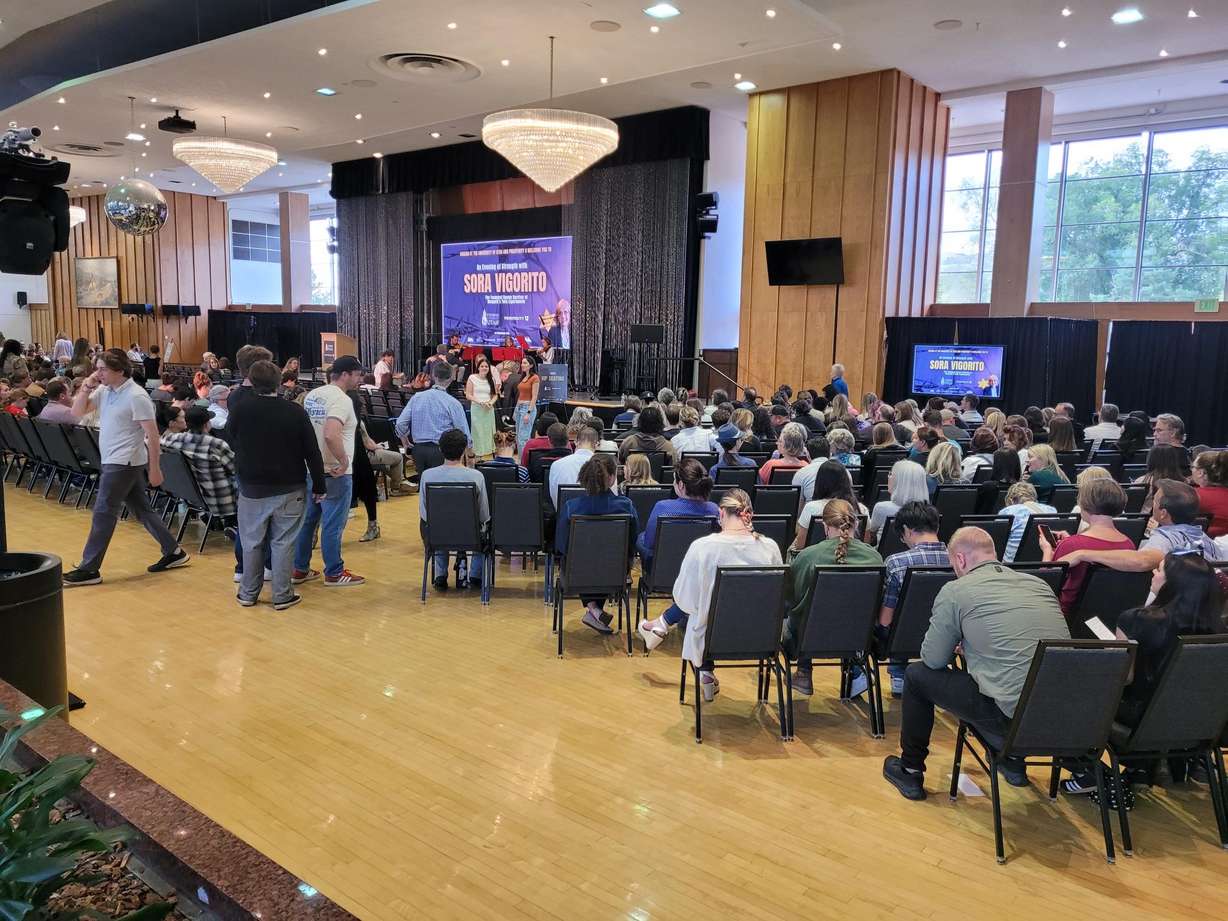
Hundreds crowded into the Student Union building on campus to hear the experiences of Sora Vigorito, a woman who was nearly murdered when she was less than four years old.
Vigorito arrived with little fanfare, smiling as she entered the auditorium and greeting people before sitting in the audience.
Rabbi Moshe Nigri, who originally reached out to Vigorito, said they had as many as 1,500 people sign up for the event before they were forced to close reservations, simply because there was not enough room.
Hundreds of people also joined remotely, watching her tell her story from outside the building.
Nigri opened up the night after a quartet of musicians from the LDS Institute of Religion performed prelude music.
Following remarks from him, his wife, Charlie Freedman, the executive director of University Interfaith Initiatives and Ethan Smith, president of Chabad on Campus at the University of Utah, Vigorito began to share her story.
Story of her survival
She said she doesn't remember her mother at all. Her mother had taken her older sister to beg for food when they disappeared, likely kidnapped by the Nazis and taken to Auschwitz.
She recalled a single emotion throughout her childhood: fear. Fear of the men with dark uniforms and shiny buttons, fear of the cattle cars they were stuffed inside and fear of being alone.
She said that fear helped keep her alive.
Her grandmother, whom Vigorito called Baba, tried to shield her and her twin sister, Hana, from the guards at Auschwitz. Unfortunately, the guards discovered the twins and separated them from her grandmother.
"It was the gateway to hell," she said, recalling the gate over the entrance to Auschwitz I.
Vigorito was detained by Dr. Josef Mengele, a Nazi doctor who experimented on pairs of twins and people with inherited anomalies.
Vigorito and her sister were taken to the hospital at Auschwitz II-Berkinau, where Mengele performed his experiments. Once there, they were placed in a cage; Vigorito's new home and her sister's deathbed.
Both Vigorito and her sister were given injections into their spines. These injections would make them seize up in pain. Shortly after one of the injections, Vigorito's sister died.
"What hurts so much is the spiritual and emotional damage that was done to us," she said.
She recalled holding her sister's body, not wanting to be alone. When Mengele came to collect her sister's body, she knelt over her body and slapped Mengele across the face.
After her sister was taken away, Vigorito was scheduled to die. After one twin died, Mengele would often kill the other twin to perform autopsies on them both.
Vigorito recalled a woman, whom she called an angel, unlocking her cage and hiding her from Mengele, so she would not be killed along with her sister.
Vigorito spent less than a year inside the camps before they were liberated. After she was freed, she reunited with her grandmother in East Germany. She was then smuggled over the border to West Germany, never to see her grandmother again.
Story of her trauma
Following her experiences in the camp, Vigorito said she was numb for decades after the camps.
She had been taught what death meant when she was just three years old, and never knew anything other than the horrors of hiding and the torture within the camps.
She said she could feel nothing and acted "like a robot, even as a small child." She said her soul was dead.
She reunited with her father after the camps, and the two of them immigrated to Canada and then the United States. Soon after, her father became unable to care for her, and she went into the foster system.
She left school when she was 17 after her foster parents kicked her out. She became a waitress, then eventually met her husband while waiting tables.
The two of them married in November of 1968 and eventually had four children and nine grandchildren. She said she remembers sitting at a table with her family, marveling that she had a family again.
"It's amazing to me," she said.
Story of her revival
More than 80 years after the liberation of Auschwitz II-Birkenau, Vigorito said she still has new details resurfacing in her memories. Every time she tells the story, something new comes back to the forefront of her mind.
She said this was the largest group of people that she had ever talked to. While she said she doesn't get stage fright, she also said she wants to leave people with more than just a story.
"I have a goal: I want to reach people," Vigorito said, pointing to her heart. "If I don't reach them, it's a waste of time. I want to reach it in here. I don't want them just to listen. It's not a lecture. This is not a lecture. This is testimony."
This goal came after speaking with a rabbi many years ago. She asked him why she had survived when her twin, her mother, her older sister and countless others had not.
The rabbi told her that she had a mission to complete, to share her experiences and to teach others. As she considered his words, she began to internalize them.
The rabbi gave her back the promises of God, not of history, but of responsibility. She said that from her life experiences, she could begin to use her personal hell to build heaven.
She realized that while God may have felt distant, he was still there watching over her with a plan for her.
"He was always there in my hell, in Auschwitz, in Birkenau," she said. "God brought me back and revived my soul."
Her story brought tears to the eyes of some in attendance. The audience erupted into a standing ovation as she concluded, her story shared with the rising generation as a testimony to resilience and faith.
Watch a recording of the livestream below:

Most recent Utah stories
Related topics
 Joe Wirthlin