Estimated read time: 8-9 minutes
This archived news story is available only for your personal, non-commercial use. Information in the story may be outdated or superseded by additional information. Reading or replaying the story in its archived form does not constitute a republication of the story.
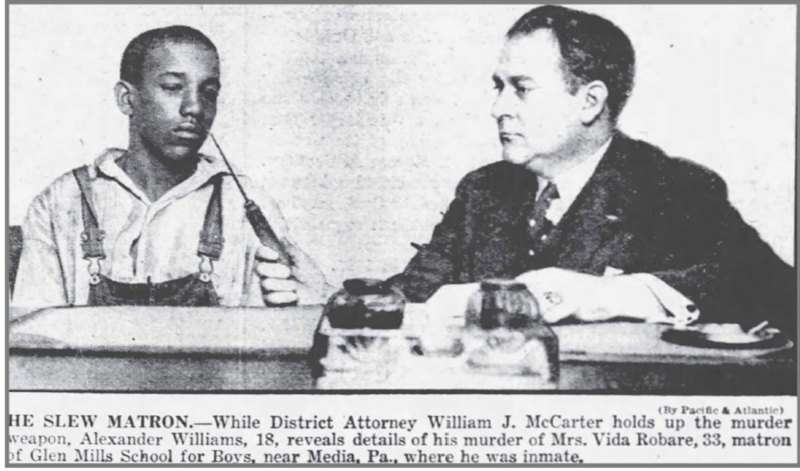
(CNN)— For 85 years Susie Williams Carter believed her brother was guilty of the crime he’d been convicted of and executed for: A brutal murder of a White woman at a Pennsylvania youth detention center. In 1931, Alexander McClay Williams became the youngest person to be executed in Pennsylvania, when his death sentence was carried out by electric chair at the age of 16. Alexander was convicted of murdering Vida Robare, the matron at the Glen Mills School, a youth detention facility where he was housed located just outside of Philadelphia. Carter, who was a year old at the time of her brother’s execution, told CNN her family rarely discussed Alexander as it was painful for her mother and father to relive the anguish and heartbreak of his execution. But in 2015, all that changed. That’s when Carter, the only living sibling of the family of 13 children, was presented with evidence that shifted an image she held of her brother for decades. Now, more than 90 years after his execution, Carter and her family are suing the county for damages, alleging that Alexander was “improperly arrested and subjected to the horrors of imprisonment, unfairly tried, wrongfully convicted and ultimately executed in the electric chair for a crime he did not commit,” according to the lawsuit filed last week in the district court for eastern Pennsylvania. CNN has reached out to the district attorney’s office for comment on the lawsuit. Carter, who is 94, told CNN she wants to raise awareness that wrongful convictions continue to plague young people of color across the US. “I want them (the public) to realize that these things are still going on,” Carter said. “Something should be done to stop it.”
‘They made no effort to hide what they did’
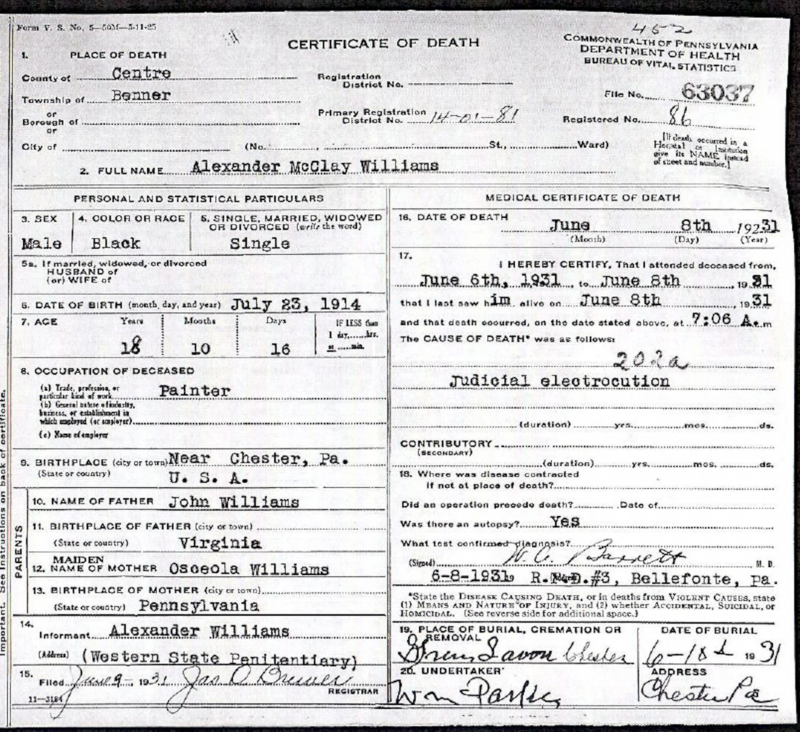
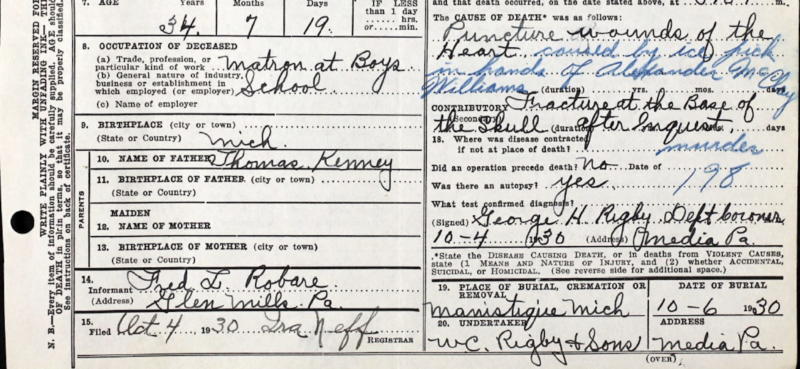
On Oct. 3, 1930, Robare’s body was discovered by her ex-husband Fred, who also worked at the Glen Mills School, according to the complaint. She “had been stabbed 47 times with an ice pick and suffered two broken ribs and a skull fracture,” according to the Death Penalty Information Center, a nonprofit that maintains an extensive database on capital punishment cases in the United States. A local newspaper, The Chester Times, “reported that district attorneys and detectives had reviewed the ranks of Glenn Mills’ students and decided to question” Alexander, according to the complaint. It’s unclear why he was singled out from the group. William Ridley, the first African American admitted to the Bar of Delaware County, represented Alexander at trial. His great-grandson, Sam Lemon, told CNN he’s been enthralled by Ridley’s trailblazing career since he was a child. So much so, he lives in Ridley’s home in Media, Pennsylvania, about 20 miles outside of Philadelphia. “I wanted to know, why did he (Ridley) lose probably the most important law case of his entire legal career?” Lemon said. “It was a little bit of a debt of honor, trying to figure out why that was and (find) some way to see if I could explain that to the Williams family or make that better.” So, in 1989 Lemon began writing letters, collecting documentation and visiting the Philadelphia Historical Society to view archival records about the case. He acquired death certificates and digested genealogy through ancestry archives – all to better understand how Alexander was convicted. As he researched, Lemon found the 1930 death certificate from the prison doctor and, he said, it appeared someone had altered the boy’s age to make it read that he was 18 years old when he was, in fact, 16.“But they forgot to change the birth year to make the math work,” Lemon said. Lemon said he also noticed it listed the day she died as Oct. 3 and an autopsy was completed the following day. Robare’s cause of death was written in black ink: “puncture wounds of the heart,” a document in the family’s complaint shows. But somebody, in what appears to be different handwriting, wrote “caused by ice pick in the hands of Alexander McClay Williams” in blue ink, Lemon said. But Alexander hadn’t been convicted yet. The complaint notes this discrepancy as well.Reading over the document made him nauseous, Lemon said. “It made me physically ill; I thought I was gonna have to reach for a trash can,” he said. There weren’t any eyewitnesses to the crime or physical or forensic evidence that connected Alexander with the murder, the complaint states. An adult’s bloody handprint was found at the murder scene, but that evidence was not introduced at trial and an officer later testified that he did not observe any blood on Alexander, according to the complaint. But, Lemon said, it wasn’t until he reviewed the original 300-page transcript from the trial that all the pieces fell into place. “When I read that, it was just stunning,” he told CNN. “But what really astonished me was, they made no effort to hide what they did.” On the day of the murder, a school officer asked Alexander and another boy to get shovels that were “located between one and two blocks away.” He then asked Alexander run a separate errand – a task that the officer said took the boy 20 minutes to complete, according to the complaint. At trial, the Commonwealth argued that within those 20 minutes, Alexander committed the murder, according to the complaint. Lemon said when he outlined all the teen was accused of doing within that short time frame he counted 15 separate actions. “That’s when I hit this eureka moment that this was impossible,” he said. “So, I started doing these walking tests, time trials around my hometown in Media and I measured distances with my car and a stopwatch, and it came to me that it was just impossible. It was impossible for him to do all these things in 20 minutes and then go back to work without any blood on him whatsoever.” After two decades of research, Lemon decided he had collected enough information to present his findings to Carter and her family. He prepared a 45-minute PowerPoint presentation for the Williams family, who listened politely and quietly in the living room of a family home, he said, as he revealed why he believed Alexander was wrongfully convicted. “They were kind of stunned because they didn’t know about this stuff,” Lemon said. Lemon made a promise to Carter and her family that he was going to help them clear Alexander’s name. “There was a lot of shame associated with the family in addition to kind of having to suffer in silence,” Lemon said. “I feel honored that these people took this stranger out of the blue and trusted me, talking about probably the most important family memory that they had and an extremely painful one at that.”
‘We cannot undo the past’
It took more than two weeks for Alexander to be appointed an attorney, during which time he was interrogated at least five times “without the benefit of an attorney or parent present,” according to the complaint. Alexander initially denied involvement but eventually “confessed” to the crime three times, but the complaint alleges the confessions were coerced. At trial, Alexander “faced an all-White jury, which found him guilty in less than four hours,” according to a 2022 statement from the county’s district attorney’s office. In 2017, the case against Alexander Williams was reopened thanks to the legal advocacy from Lemon and attorney Robert Keller, who posthumously represented the teen in court proceedings as Lemon and the family sought to overturn his conviction. In June 2022, a judge from the Delaware County Court of Common Pleas ordered a retrial and the Delaware County District Attorney’s office declined to bring the case. The case was dismissed in, “an acknowledgement that the charges against him should never have been brought,” according to the statement from the district attorney’s office at the time. “Sadly, we cannot undo the past,” District Attorney Jack Stollsteimer said in the statement. “We cannot rewrite history to erase the egregious wrongs of our forebearers. However, when, as here, justice can be served by publicly acknowledging such a wrong, we must seize that opportunity.” In October 2022 – more than 90 years after he was sentenced to death – Alexander was exonerated by then-Pennsylvania Gov. Tom Wolf, according to the Philadelphia Inquirer. More than 150 people were exonerated in the US in 2023. Of those, nearly 84% were people of color, nearly 61% of the exonerees were Black and the most frequent factor in the exonerations was official misconduct, according to data from The National Registry of Exonerations. The Emmett Till Legacy Foundation, which honors the memory of the 14-year-old Black teen who was kidnapped, brutally beaten and murdered in 1955 by two White men after he was accused of assaulting a White woman, offered a statement of support to the Williams family, saying they are inspired by their “long and overdue quest for truth, justice and accountability.” “No family should endure the type of historical and generational trauma that their family, ours and so many others have experienced for this long,” the statement said. “Unfortunately, it is a continuous throughline of injustice, across this country that still impacts us today.” Carter said she has continued to fight to clear her brother’s name – even after all this time – because she wants to raise awareness that what happened to him, continues to happen to others. She imagined her parents sitting through her brother’s trial with great difficulty, hearing about the things Alexander was accused of doing, knowing that their son was innocent. “And yet (the commonwealth) let him die,” she said. “That’s a terrible thing to do a family.”
CNN’s Justin Gamble contributed to this report.