'%3e%3cpath%20d='M34.1406%205.85938C30.3906%202.10547%2025.3047%200%2020%200C14.6953%200%209.60938%202.10547%205.85938%205.85938C2.10938%209.61328%200%2014.6953%200%2020C0%2025.3047%202.10547%2030.3906%205.85938%2034.1406C9.61328%2037.8906%2014.6953%2040%2020%2040C25.3047%2040%2030.3906%2037.8945%2034.1406%2034.1406C37.8906%2030.3906%2040%2025.3047%2040%2020C40%2014.6953%2037.8945%209.60938%2034.1406%205.85938ZM37.0117%2023.543H31.1602V13.5391H27.6328V19.9414C28.1211%2020.6914%2028.3711%2021.582%2028.3711%2022.5625V22.625C28.3711%2023.668%2028.1172%2024.6055%2027.6328%2025.4297V26.6094H36.082C33.4883%2032.9375%2027.2891%2037.3789%2020.0039%2037.3789C10.3711%2037.3789%202.62109%2029.6289%202.62109%2020C2.62109%2010.3711%2010.3711%202.62109%2020%202.62109C29.6289%202.62109%2037.3789%2010.3711%2037.3789%2020C37.3789%2021.1484%2037.2617%2022.2656%2037.0508%2023.3477C37.0391%2023.4141%2037.0234%2023.4766%2037.0117%2023.543Z'%20fill='white'/%3e%3cpath%20d='M22.3086%2018.5352C20.4336%2018.125%2019.9531%2017.8398%2019.9766%2017.1836V17.1406C19.9766%2016.6992%2020.3477%2016.2148%2021.4023%2016.2148C22.582%2016.2148%2023.8867%2016.6797%2025.0781%2017.4766L26.8516%2015.0195C25.4453%2013.8906%2023.707%2013.3398%2021.5547%2013.3398C18.5195%2013.3398%2016.4375%2015%2016.4063%2017.4766V17.5352C16.3633%2020.2617%2018.5859%2020.9805%2021.293%2021.6016C23.0391%2021.9766%2023.5703%2022.3164%2023.5703%2022.9609L23.5469%2022.9766C23.5469%2023.3906%2023.2578%2023.7031%2022.7852%2023.8359C22.5742%2023.9062%2022.1289%2023.9727%2021.5156%2023.9727C20.7617%2023.9727%2019.7539%2023.8633%2018.6328%2023.4844C18.0898%2023.2891%2017.4727%2023.0039%2016.8047%2022.6133L20.1406%2026.625C20.2813%2026.6602%2021.0977%2026.8516%2021.7734%2026.8516C25.0039%2026.8516%2027.0859%2025.2461%2027.1094%2022.6328V22.5703C27.1602%2020.1133%2025.2148%2019.1719%2022.3086%2018.5352Z'%20fill='white'/%3e%3cpath%20d='M5.24219%2013.5664V26.6133H8.75391V23.7578L10.2969%2021.9531L14.2031%2026.6133H18.3867L12.3555%2019.5195L17.4023%2013.5664H13.4531L8.75391%2019.0586V13.5664H5.24219Z'%20fill='white'/%3e%3c/g%3e%3cdefs%3e%3cclipPath%20id='clip0_97_2430'%3e%3crect%20width='40'%20height='40'%20fill='white'/%3e%3c/clipPath%3e%3c/defs%3e%3c/svg%3e)


- Syed Sohail, a Muslim man attacked at Valley Fair Mall last week, addressed a gathering called to draw attention to the dangers Utah's Muslim community can face.
- He hopes the attack he experienced "serves as a reminder that every human being deserves to live in peace, safety and dignity."
- Other participants stressed the importance of efforts to counter Islamophobia.
WEST JORDAN — In the wake of the knife attack he sustained at Valley Fair Mall last week, Syed Sohail — allegedly targeted because he's Muslim — hopes some good comes from the violent turn of events.
"I hope this incident serves as a reminder that every human being deserves to live in peace, safety and dignity, regardless of the religion, race and background," he said Wednesday.
He even offered conciliatory remarks to his alleged attacker, Peter Michael Larsen, charged with two counts of attempted aggravated murder in the matter, saying he doesn't harbor any hatred toward him.
"I sincerely pray to Allah. Bless his soul, guide him to the right path and fill his heart with kindness and compassion," Sohail said.
Sohail, out of the hospital, is still in pain, but he gathered the strength to address, via video from his home, a town hall meeting called in response to the July 13 attack he faced that was held at the Utah Islamic Center in West Jordan. Members of the Muslim community, law enforcement officials, state lawmakers and others took part as a show of solidarity, participants variously warning of an uptick in violence against Muslims and stressing the importance of reporting incidents to police.
Some also broached the idea of pursuing anti-hate legislation targeting Islamophobia.
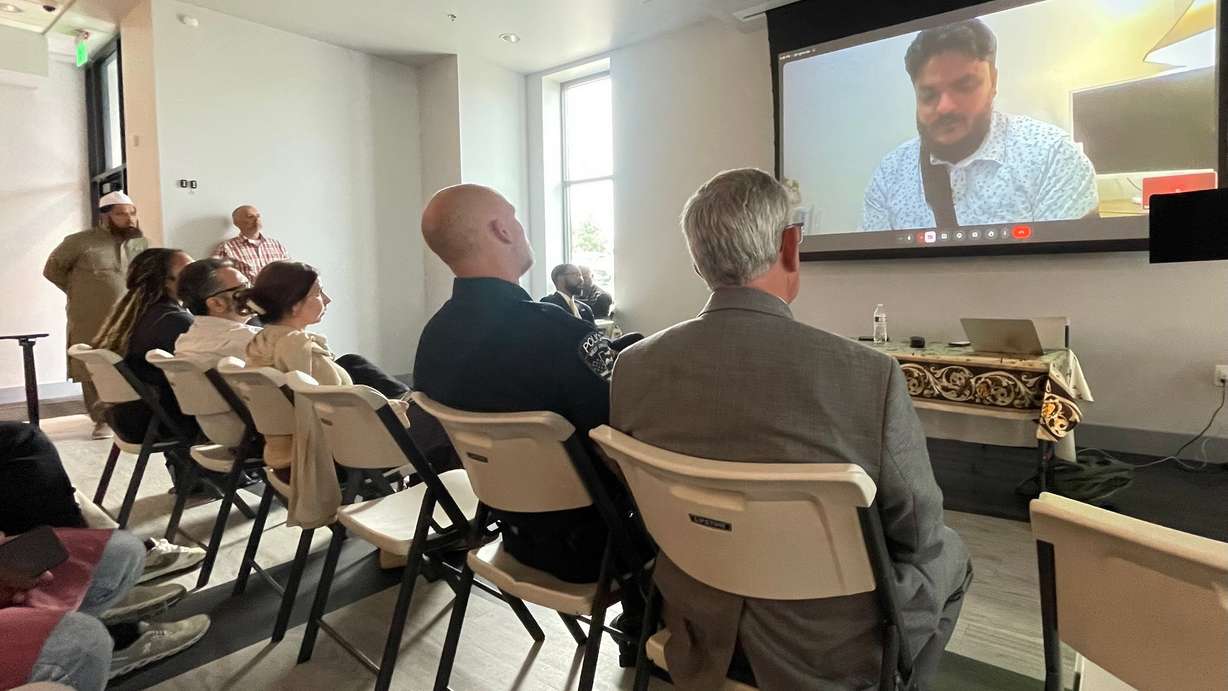
Shuaib Din, the imam of the Utah Islamic Center, said the attack on Sohail may stand out as the most violent incident faced by a member of Utah's Muslim community. But he's not alone.
"Believe me, there are a lot more victims. There's a long list, far too many," he said.
Din hopes Wednesday's gathering serves to spark efforts to craft more comprehensive anti-hate legislation at the state level protecting the Muslim community.
"The purpose is that we would like to see some concrete steps that are taken to assure the safety of our community and all communities, all minorities," he said.
Larsen allegedly attacked Sohail at Valley Fair Mall in West Valley City because of his Muslim faith, stabbing the victim multiple times before passersby were able to intercede. Larsen also allegedly attacked another man who tried to help and threatened him, resulting in the second attempted aggravated murder charge, both with hate crime enhancements.
Edward Ahmed Mitchell, deputy director of the Council on American-Islamic Relations, or CAIR National, traveled from the group's headquarters in Washington D.C. to Utah as a show of solidarity. He also took part in Wednesday's town hall following a meeting earlier in the day with Sohail.
"Anti-Muslim hate is out of control because people with microphones, people with platforms, people with power are deliberately stoking anti-Muslim hate to win primaries, to get social media followers, to silence Muslims who are critical of American foreign policy," Ahmed Mitchell said. "There are different motivations, but the common denominator is they are willing to put their neighbors, their Muslim neighbors, at risk to accomplish their goals. Hate speech very often can easily lead to hate crimes."
Hibba Ahmed, a Muslim woman who uses a hijab, addressed the group, noting in particular the attention Muslim women can draw because of their garb.
The attack on Sohail "is a tragic incident, but for visibly Muslim women, it's a reminder of the reality that we carry every single day," she said, of potentially facing anti-Muslim backlash. "When many Muslim women put on our hijabs each morning, we do not have the privilege of choosing when our faith is visible."
Like Din, she hinted at the need for more than gestures of sympathy in the wake of incidents like last week's attack.
"We need leaders who are willing to come and listen, to understand our lived experiences and to include us in conversations about public safety," she said. "Addressing Islamophobia cannot be reactive. It must be proactive. Our public safety agencies also have an essential role to play."
Ahmed said Muslim community members need to feel comfortable reporting incidents they face to police. Similarly, the law enforcement officials on hand, which included West Jordan Police Chief Jeremy Robertson and Salt Lake County District Attorney Sim Gill, stressed the importance of reaching out to police.
"Hate crimes are vehemently underreported," Gill said.
Read more:

Multicultural Utah
Looking for more news about the different cultures that call Utah home? Visit our Multicultural Utah section for more stories, events and features.Several Democratic Utah lawmakers took part in Wednesday's gathering, including Sen. Luz Escamilla and Rep. Angela Romero, who represent portions of Salt Lake City. Escamilla referenced successful efforts in prior years to pass anti-hate legislation, but stressed that more needs to be done, potentially more focused efforts on tracking hate crimes, which could inform new policy.
"It's time for that conversation," she said. Many lawmakers, she went on, "will see why this is valuable because at the end of the day, today it's one group, tomorrow it could be you, and that's something we all need to acknowledge, that it is closer than we sometimes think it is."

Related stories
Most recent Politics stories
Related topics
 Tim Vandenack