'%3e%3cpath%20d='M34.1406%205.85938C30.3906%202.10547%2025.3047%200%2020%200C14.6953%200%209.60938%202.10547%205.85938%205.85938C2.10938%209.61328%200%2014.6953%200%2020C0%2025.3047%202.10547%2030.3906%205.85938%2034.1406C9.61328%2037.8906%2014.6953%2040%2020%2040C25.3047%2040%2030.3906%2037.8945%2034.1406%2034.1406C37.8906%2030.3906%2040%2025.3047%2040%2020C40%2014.6953%2037.8945%209.60938%2034.1406%205.85938ZM37.0117%2023.543H31.1602V13.5391H27.6328V19.9414C28.1211%2020.6914%2028.3711%2021.582%2028.3711%2022.5625V22.625C28.3711%2023.668%2028.1172%2024.6055%2027.6328%2025.4297V26.6094H36.082C33.4883%2032.9375%2027.2891%2037.3789%2020.0039%2037.3789C10.3711%2037.3789%202.62109%2029.6289%202.62109%2020C2.62109%2010.3711%2010.3711%202.62109%2020%202.62109C29.6289%202.62109%2037.3789%2010.3711%2037.3789%2020C37.3789%2021.1484%2037.2617%2022.2656%2037.0508%2023.3477C37.0391%2023.4141%2037.0234%2023.4766%2037.0117%2023.543Z'%20fill='white'/%3e%3cpath%20d='M22.3086%2018.5352C20.4336%2018.125%2019.9531%2017.8398%2019.9766%2017.1836V17.1406C19.9766%2016.6992%2020.3477%2016.2148%2021.4023%2016.2148C22.582%2016.2148%2023.8867%2016.6797%2025.0781%2017.4766L26.8516%2015.0195C25.4453%2013.8906%2023.707%2013.3398%2021.5547%2013.3398C18.5195%2013.3398%2016.4375%2015%2016.4063%2017.4766V17.5352C16.3633%2020.2617%2018.5859%2020.9805%2021.293%2021.6016C23.0391%2021.9766%2023.5703%2022.3164%2023.5703%2022.9609L23.5469%2022.9766C23.5469%2023.3906%2023.2578%2023.7031%2022.7852%2023.8359C22.5742%2023.9062%2022.1289%2023.9727%2021.5156%2023.9727C20.7617%2023.9727%2019.7539%2023.8633%2018.6328%2023.4844C18.0898%2023.2891%2017.4727%2023.0039%2016.8047%2022.6133L20.1406%2026.625C20.2813%2026.6602%2021.0977%2026.8516%2021.7734%2026.8516C25.0039%2026.8516%2027.0859%2025.2461%2027.1094%2022.6328V22.5703C27.1602%2020.1133%2025.2148%2019.1719%2022.3086%2018.5352Z'%20fill='white'/%3e%3cpath%20d='M5.24219%2013.5664V26.6133H8.75391V23.7578L10.2969%2021.9531L14.2031%2026.6133H18.3867L12.3555%2019.5195L17.4023%2013.5664H13.4531L8.75391%2019.0586V13.5664H5.24219Z'%20fill='white'/%3e%3c/g%3e%3cdefs%3e%3cclipPath%20id='clip0_97_2430'%3e%3crect%20width='40'%20height='40'%20fill='white'/%3e%3c/clipPath%3e%3c/defs%3e%3c/svg%3e)




- Rep. Mike Kennedy argued states should control IVF and surrogacy laws, not the federal government.
- Grindr's lobbying for IVF access has sparked debate on family definitions and child welfare.
- Kennedy also opposes federal vaccine mandates, advocating state-level decision-making on healthcare issues.
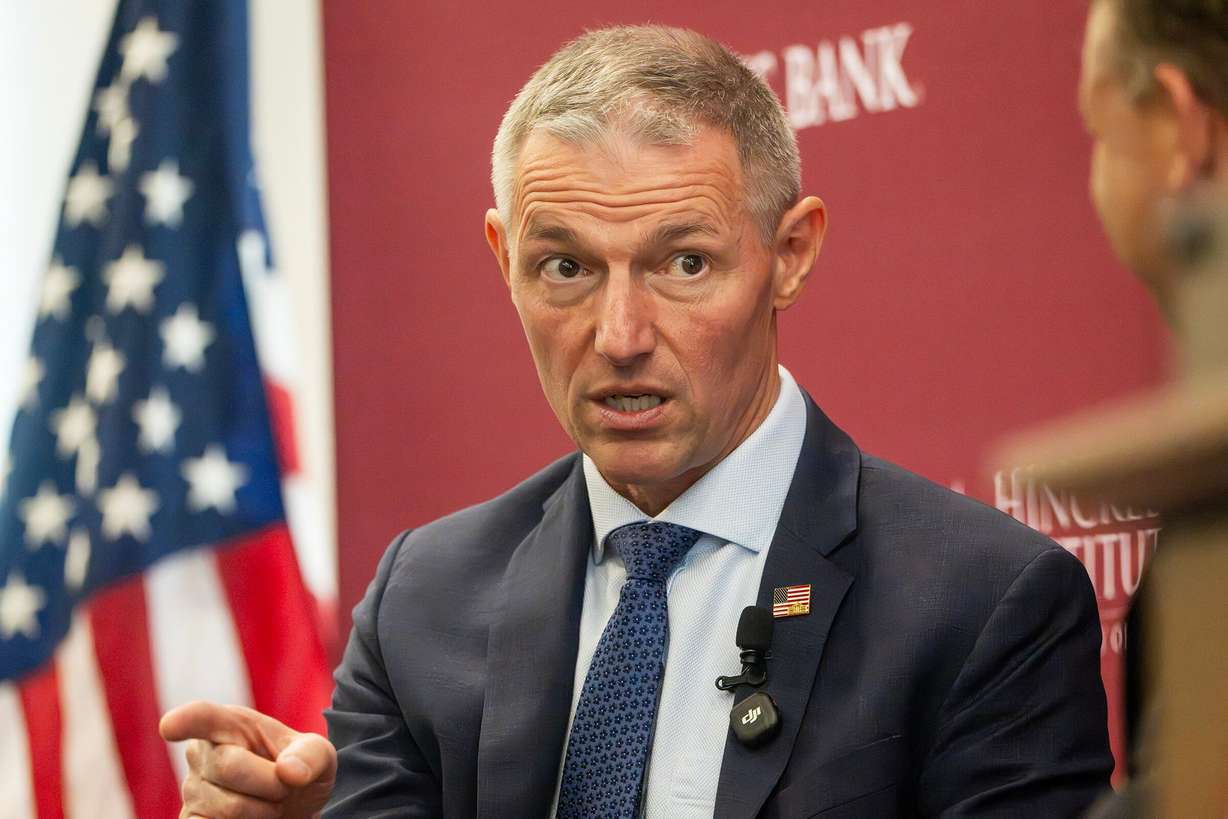
SALT LAKE CITY — Rep. Mike Kennedy sidestepped disagreements over vaccine schedules and fertility treatments during a Sutherland Institute forum on Tuesday, saying the federal government should not decide how parents conceive children or when they should vaccinate.
On vaccines, the congressman running for reelection in the 4th District, who is a medical doctor, said he opposes the concept of federal bureaucrats dictating what is and what is not "science." Congress should eliminate some positions to "get out of the business of that," he said.
"Let's let the states do that," Kennedy told the Deseret News about IVF and surrogacy. "I would prefer to see states do more if they're going to step into this area."
But Kennedy's preference for state-level solutions has not stopped calls for lawmakers to overhaul healthcare policy from arriving at Washington, D.C.'s doorstep.
One group catching attention on the Hill is Grindr, an LGBTQ dating app. CEO George Arison, a self-described conservative, has launched a multi-million-dollar lobbying campaign to make surrogacy via in vitro fertilization easier for same-sex couples.
The group hosted an inaugural White House Correspondents' Dinner in April for Republicans and Democrats — and has quickly accelerated its efforts to persuade legislators on both sides of the aisle to make key changes to fertility policies, Arison told Politico.
In a joint op-ed last month, Arison and Sen. John Hickenlooper, D-Colo., urged Congress to make IVF and surrogacy fully tax-deductible, update federal insurance rules so employers can offer full coverage for IVF and surrogacy, and change the law defining parentage.
This would include following Colorado's lead by allowing same-sex couples to establish legal rights before a baby is born, and copying California's policy last year that redefines infertility from a medical condition to include same-sex couples or even single people.
Underlying the debate are conservative concerns, at the state and federal levels, about what such changes will mean for children and the definition of family.
Conservatives conflicted on IVF, surrogacy
Some of this sounds a lot like what President Donald Trump promised during the 2024 election. Naming himself "the father of IVF," Trump said his administration would either directly pay for IVF treatments or require it of insurance companies.
The goal was to increase the number of children being born, Trump claimed. But the issue divided Republicans, with politicians like Alabama Sen. Katie Britt calling it "fundamentally pro-family," and policy experts like Patrick Brown calling it an ethical "Pandora's box."

While the administration has yet to push for significant changes to IVF regulations, it did strike a deal last year to lower the cost of some fertility medications. And New York Republican Rep. Mike Lawler has introduced legislation to offset IVF costs with tax credits.
However, some advocates believe the entire conversation around IVF and surrogacy often fails to prioritize the most important factor: the child.
The recent push by Grindr to subsidize surrogacy based on a new interpretation of infertility reveals how the legalization of gay marriage reframed the family around adult sexual identity as opposed to procreation, according to Them Before Us founder Katy Faust.
"When you treat children like items to be cut and pasted because adult identity is elevated above their rights, what you're doing is you're victimizing the most vulnerable among us, probably because you don't have political courage," Faust told the Deseret News.

Instead of collaborating with Grindr, Faust said Republican officials should "shut down" what she called "the manufacturing of motherless children."
One of the most concerning aspects of the lobbying effort in Congress for religious conservatives like Faust is how it is attempting to apply the label of infertility to relationships that are ultimately "sterile" because they are biologically incapable of producing offspring.
Will Utah change IVF and surrogacy laws?
For former state Sen. Derek Kitchen, who successfully sued the state in 2013 to legalize gay marriage in Utah, the basic principle of expanding IVF and surrogacy access is simple — to help Utahns build their families here without breaking the bank.
"Our laws should recognize that families are formed in different ways," Kitchen told the Deseret News in a statement. "Here in Utah, we talk a lot about being a pro-family state. Helping people actually build families seems like a pretty good place to start."

Salt Lake City Councilmember Chris Wharton sees the issue in much the same way. If conservatives want to be consistent in their pro-life views, then they should jump at the opportunity to help cover the costs of welcoming a child into a stable and loving home, he said.
Wharton speaks from experience. He and his husband navigated an expensive yearslong process, that included creating a GoFundMe*, to adopt their child.
The policies Grindr is lobbying for at the federal level are focused on child wellbeing, according to Wharton, because they will help prospective parents have the resources to raise the child without the overwhelming financial stress of bringing them into the world.
But pro-family appeals do not always satisfy worries that IVF is creating new frontiers of commercialized conception unmoored from the traditional family.
This is the conversation state leaders need to have, Rep. Mike Petersen, R-North Logan, told the Deseret News. The industry currently has relatively few guardrails, Petersen said. And he agrees with Kennedy that states should take the lead on finding solutions.

After unsuccessfully proposing a requirement a few years ago for fertility clinics to report how many embryos they create, implant and discard, Petersen has opened a bill file for next session that would require a background check for all IVF participants.
His bill would ensure individuals on the sex offender registry cannot participate in IVF, but he said it would also allow lawmakers to discuss IVF more broadly.
Should Washington care about vaccines?
Trump's return to the White House was accompanied by a transformation of the healthcare status quo. Secretary of Health and Human Services Robert F. Kennedy, Jr., initiated reviews of child vaccine recommendations, which were halted by the courts.
The secretary has helped to mainstream speculations about the risks he believes are associated with vaccines, such as autism, a claim disputed by experts.
When Kennedy was asked by a student on Tuesday whether he, as a practicing family physician, agreed with the direction of healthcare, the congressman said his problem is with federal overreach, not the ideology of the current agency heads.
"My response to that is we need to shrink the federal government and get some of these people out of the business of that," Kennedy said at the Sutherland event. "I'm warning you right now, that position shouldn't be there. We don't need a chief doctor."
Disagreements, like those that erupted over the COVID-19 pandemic, would be largely avoided if states could determine their own policy, according to Kennedy. Science is not about a unified approach, Kennedy said, but rather a "patchwork quilt" of experiments.
His views on the federal role of regulating vaccines and IVF were largely the same, he explained, that the federal government should do "far less."
*KSL does not assure that the money deposited to the account will be applied for the benefit of the persons named as beneficiaries. If you are considering a deposit to the account, you should consult your own advisers and otherwise proceed at your own risk.