
- President Dieter F. Uchtdorf honored 41 German prisoners of war at Fort Douglas Cemetery on Sunday.
- He emphasized remembering war's sorrows and fostering peace through compassion and reconciliation.
- Others praised Utah's tradition of honoring German soldiers annually.
SALT LAKE CITY — President Dieter F. Uchtdorf, acting president of the Quorum of the Twelve Apostles of The Church of Jesus Christ of Latter-day Saints, joined German consulate officials at Fort Douglas Post Cemetery on Sunday to honor 41 prisoners of war buried there.
With a German flag tied around his neck, President Uchtdorf shared messages of the sorrows of war, the importance of remembering people who died and becoming a peacemaker in the aftermath of grief.
President Uchtdorf's grandson wore the same tie as his grandfather. Four of President Uchtdorf's great-grandchildren were also at Fort Douglas, and three of them attend a German immersion school.
President Uchtdorf's family was at Fort Douglas for Volkstrauertag, an annual German day of remembrance similar to Veterans Day. The ceremony has been held at the cemetery since 1977.
"We remember those who died in war, but those who suffered under tyranny and violence," he said. "But remembrance is more than looking backward. It has to be looking forward. It has to be creating a future which will dare us to gain peace in many ways."
President Uchtdorf served as a fighter pilot in the German Air Force and earned his wings in the United States while training with the U.S. Air Force. During his speech on Sunday, he gratefully recalled being 18 when he first joined the military in Germany in 1959. At the time, he was assigned to an event like the one at Fort Douglas.
On days like Volkstrauertag and Veterans Day, he said it's important that people remain aware of the sorrows of war, which reach across borders and touch families on every side of conflict.
President Uchtdorf shared more about the importance of peace, explaining how families of soldiers lost to war needed help back then, and how service to peace continues today by defending human dignity, helping a neighbor and treating others with compassion even in moments of disagreement.
The graves at Fort Douglas and other places now tell a quiet, powerful story.
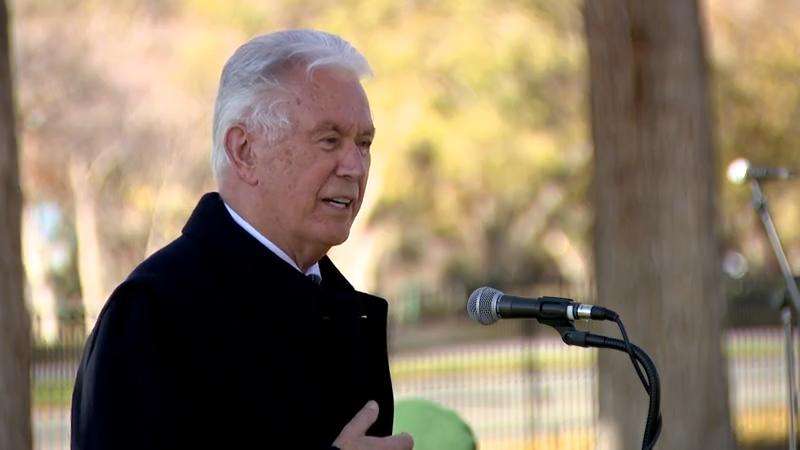
"In life, some of these men belong to opposing nations. In death, they rest in the same ground," President Uchtdorf said. "Their resting place does not erase the pain of war, but it invites us to remember that every person has a name — every person has a name, a family, and a God-given birth."
He explained how prophets have taught followers of Jesus Christ to be peacemakers in their homes, communities and in the way they speak to one another.
"That's where it starts," President Uchtdorf said. "If we treat each other with more compassion, with humility and with more tolerance, peace is around the corner."
He also spoke of using the path of reconciliation, or repentance, to remember those who have passed on. He explained that it's good to let memories deepen a person's desire to care for the living and future generations.
German Brig. Gen. Gunnar Brügner has been a soldier for over 39 years. He told the story of what people might experience at the cemetery.
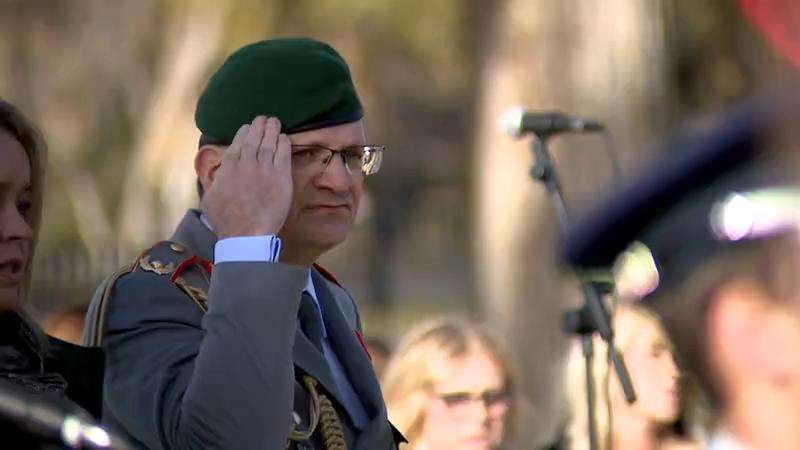
When Brügner was still a teenager in 1983, he traveled with his brother and father from Germany to Normandy, France, and visited the site of D-Day. His father, born in 1925, had fought in the war.
"During our journey, he was determined to find a very specific soldier's grave," Brügner recalled. "One of his brothers is buried there at the cemetery La Cambe, along with 21,221 other German soldiers who fell on that front."
Brügner eventually found a map marking his uncle's grave. All of Brügner's other uncles died while fighting on the Eastern Front and remain missing to this day.
"It was a moving moment for my father, my little brother and me, and I can assure you I have not seen my father very often in tears," Brügner said. "When you stand in these vast cemeteries, as a young man, as I did, it changes your perspective."
Brügner believes relatives of the people buried at Fort Douglas may have taken a similar journey and likely experienced what he did.
German Consul General Andrea Sasse also spoke during Sunday's ceremony. She first attended the ceremony two years ago.
"I was extremely impressed by the care, the thought and the genuine commitment which went into honoring the German prisoners of war buried here," she said. "I still find it remarkable. Here we are, thousands of miles away from Germany, gathered at an American military cemetery to commemorate German soldiers who died during World War II."
She said most people in Germany and the U.S. are not aware of the ceremony, yet people in Utah have made it a tradition to come together year after year to pay tribute and remember.
Sasse asked those in attendance to look at the graves around them and remember just how much has changed since WWII. The Germans buried at the cemetery were soldiers — prisoners of war who died far away from their homes and families. Germany and the United States were enemies at the time. Now, Americans care for the graves of German soldiers as people stand together as allies, friends and partners, Sasse explained. She said no one should forget what led to WWII and what Volkstrauertag means today.
"We remember all victims of war and violence," Sasse said. "Soldiers and civilians. Prisoners of war. People who were persecuted and murdered because of their religion, their background or their beliefs. People who stood up against tyranny and paid for it with their lives. And we remember those who are suffering from war and violence today."