
Estimated read time: 11-12 minutes
- Salt Lake County prosecutors are using AI for evidence review, but the maintain human oversight.
- District Attorney Sim Gill emphasizes how AI aids efficiency without replacing human judgment.
- The National Prosecution Best Practices Conference is discussing AI's role in the justice system.
SALT LAKE CITY — Artificial intelligence is already being used inside the Salt Lake County District Attorney's Office, helping prosecutors sort through evidence, conduct legal research and manage growing amounts of digital information.
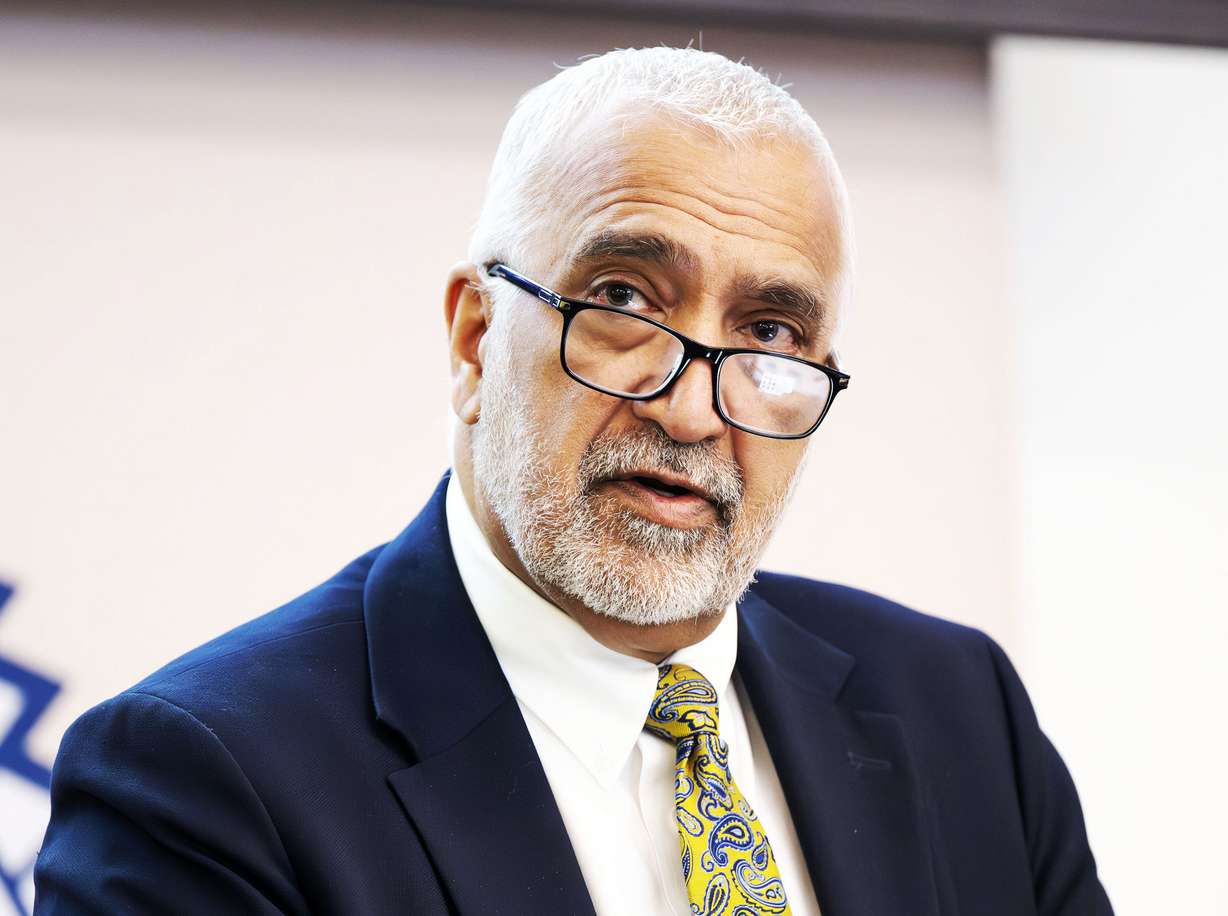
But District Attorney Sim Gill says the technology will not replace the human judgment behind decisions that can change someone's life.
Gill is hosting prosecutors and criminal justice leaders from across the country this week for the 2026 National Prosecution Best Practices Conference, where the responsible use of AI is among several issues being explored.
"Certainly the Salt Lake County (District Attorney's Office) is not surrendering its judgment to technology," Gill told KSL. "We are not surrendering our human interaction to technology."
The discussions come as prosecutors nationwide grapple with how to take advantage of increasingly powerful AI tools without compromising sensitive information, introducing errors or allowing machines to influence decisions that should remain in human hands.
For Gill, the challenge is finding ways to make his office more efficient while preserving the responsibility prosecutors have to victims, defendants and the communities they serve.
How AI is already being used in Salt Lake County
One of the biggest challenges facing modern prosecutors is the enormous amount of digital evidence generated during criminal investigations.
Body-worn cameras, for example, can produce hours of video from a single police response.
Gill described a scenario involving five officers responding to a call lasting 45 minutes. Each officer's body camera could generate a separate recording, leaving prosecutors with nearly four hours of video to review.
AI-assisted technology can help organize that information, produce searchable transcripts and direct attorneys to potentially relevant moments.
Instead of manually searching through every minute of footage to find a critical interaction, prosecutors can use technology to help identify where to look.
"So now I'm going to go (put) eyes on that myself," Gill said, explaining that the technology helps narrow the material requiring closer examination. "It helps me eliminate repetitive, unnecessary work and gets me to the heart of the matter that I need to be looking at."
Gill said his office also uses AI-assisted legal research tools within closed systems rather than open, publicly accessible platforms — an important distinction when handling protected information.
The technology can help attorneys locate relevant cases, organize information and examine opposing legal arguments. However, Gill stressed that prosecutors must still read the source material and independently verify its accuracy.
He said the office is not using AI to write court motions or make substantive legal decisions on behalf of attorneys.
The technology is also finding less obvious applications.
Gill said office leadership has used AI tools to practice difficult workplace conversations, including discussions involving employee performance and disciplinary matters.
Those exercises can help managers prepare and communicate more effectively, he said, demonstrating that AI's potential extends beyond courtroom work.
A real criminal case in Texas
For Montgomery County District Attorney Mike Holley, the potential benefits of AI are already evident in actual criminal prosecutions.
Holley, who traveled to Salt Lake City for the conference, described how his office in Texas used AI during the punishment phase of a trial involving a man convicted of sexually abusing children.
Prosecutors had subpoenaed Snapchat records containing an extensive collection of text messages.
Rather than manually searching through potentially thousands of lines of material, attorneys used an AI tool to identify conversations in which the defendant appeared to be communicating with someone identifying as a child, along with references to sexual activity.
"We used an AI tool to say, 'Show us any place where our suspect is talking to somebody who identifies as a child' and isolate those," Holley said. "And it did that very quickly. It would have taken us hours, maybe days, to do that."
We are not surrendering our human interaction to technology.
–Sim Gill, Salt Lake County district attorney
Prosecutors then checked the flagged messages against the original records before presenting the information to a judge for consideration during sentencing.
Holley said the example illustrates how AI can help attorneys uncover relevant information without consuming time that could otherwise be spent working on additional cases.
His office also uses AI-assisted legal research tools and technology that can compare information in proposed search or arrest warrant affidavits against original reports.
That comparison can help identify human errors, such as transposed numbers in an IP address or serial number.
Holley said prosecutors remain responsible for checking the results, but the technology can sometimes catch mistakes a person might overlook.

He also described staffing shortages as a significant challenge for prosecutors across the country, arguing that reducing routine workloads could give attorneys more time to meet with victims, interview witnesses and evaluate cases.
"When an office can't staff fully, that's not fair to anybody," Holley said, explaining that victims and defendants can both be affected when cases take longer to resolve.
Still, despite his office's embrace of the technology, Holley offered a striking admission.
"If I could un-invent AI, I would," he said. "But it's here, and so we're going to navigate it."
What happens when AI gets something wrong?
Both district attorneys acknowledged that some of the technology's greatest strengths also introduce significant risks.
Generative AI systems can produce inaccurate information or fabricate details, a problem commonly described as an AI "hallucination."
"AI does hallucinate. It does consistently, and it does it well. It can lie and lie well," Holley said.
He explained that attorneys using AI-assisted legal research tools may receive descriptions of court rulings that do not accurately reflect what a judge decided.
That creates an obligation to review the original material rather than relying solely on an AI-generated answer.
"Prosecutors are supposed to seek the truth and speak the truth," Holley said.
Gill raised similar concerns, pointing to instances in the legal profession where attorneys have submitted AI-generated arguments containing references to nonexistent cases.
He said his office does not use AI as a substitute for drafting substantive court motions.
Related:

Anthropic AI model submits false homicide tip to Philadelphia police website
An Anthropic artificial intelligence model submitted a false homicide tip through a Philadelphia police website, the department said in a statement, the latest incident of rogue behavior from the powerful technology.Another concern is the protection of sensitive information.
Criminal investigations can involve medical records, criminal histories, witness statements and other material that should not be accessible to unauthorized individuals.
Gill said prosecutors must understand where information goes when uploaded to an AI platform, how it is stored, who owns it and who can retrieve it.
Holley identified data security as one of his primary concerns, warning against allowing confidential information to enter systems where its protection cannot be assured.
The two prosecutors also expressed concern that attorneys could become overly dependent on AI, potentially losing critical skills in research, communication and evaluating people.
Gill described that danger as becoming "cognitively lazy."
He said he wants younger attorneys to develop the ability to connect with witnesses, communicate with juries and understand the experiences of victims rather than relying entirely on information condensed by a computer.
AI-generated police reports raise accountability questions
One issue Gill believes deserves particular attention is the emerging use of AI to help law enforcement officers generate police reports.
Some technology can turn body-camera recordings into transcripts and use those transcripts to create draft reports.
Gill said he has communicated to law enforcement that officers using such technology should disclose it and personally review the information for accuracy.
"What my communication to law enforcement has been is that if you're going to use it, then you need to mention it," Gill said.
He added that the officer responsible for the report should verify the contents rather than treating an AI-generated draft as a finished account.
"I'm not going to put AI technology to testify in court. I'm going to put that officer," Gill said. "If you're going to use it, let's disclose it."

Gill's comments describe his expectations for disclosure and verification. He did not identify a newly adopted written policy governing AI-generated police reports during the interview.
He also emphasized that the district attorney's office would not delegate charging decisions to AI.
Prosecutors must consider whether evidence supports an alleged offense, whether the elements of a crime are met, and whether pursuing charges serves the interests of justice.
Those decisions require an understanding of the people and circumstances involved, Gill said, rather than a formula producing an automatic recommendation.
Holley expressed a similar view, rejecting the prospect of AI independently deciding whether charges should be dismissed, a defendant should receive a plea offer or a case should be diverted from prosecution.
He offered a hypothetical comparison between a teenager stealing a tie for a job interview and someone stealing simply for the thrill of it.
The legal offense might be similar, Holley explained, but the circumstances and appropriate outcomes could be very different.
"I would not ever want AI to make those judgment calls," he said.
Could AI save taxpayers money?
Beyond accuracy and accountability, the use of AI raises questions about the costs of operating a prosecutor's office.
Holley said some companies are developing specialized software designed to reduce the time attorneys spend drafting routine documents or reviewing information.
He said the technology could free prosecutors to spend more time on work that requires legal expertise and human interaction.
But Gill cautioned that greater efficiency does not automatically translate into lower overall costs.
The adoption of body-worn cameras, for example, introduced a new source of evidence while also creating major storage and review demands.
AI could help prosecutors manage those workloads, but it may also require additional software, secure storage, verification procedures and new staff responsibilities.
"In the short term, in the most broadest sense, yes, I think it is going to make us more efficient," Gill said.
However, he acknowledged that the overall financial impact remains uncertain.
The discussion also reflects differences in how quickly prosecution offices are adopting AI.
I would not ever want AI to make those judgment calls.
–Mike Holley, Montgomery County (Texas) prosecutor
Holley said his office is using the technology aggressively but with controls, while some other jurisdictions are still evaluating its costs, security requirements and applications.
He pointed to neighboring Harris County, Texas, as an example of a large prosecutor's office developing its own AI system.
A national conversation about the future of prosecution
The conversations about AI are only one part of a broader gathering intended to help prosecutors rethink their work.
The National Prosecution Best Practices Conference, held Thursday and Friday in Salt Lake City, is co-hosted by the Salt Lake County District Attorney's Office, the Prosecutors' Center for Excellence and its National Best Practices Committee.
This year's theme is "Reimagining the Role of the Prosecutor: Balancing Safety, Prevention, and Public Trust."
Gill said the initiative began a decade ago as a way to bring together prosecutors from different jurisdictions and political backgrounds to share research, technology, programs and approaches that could improve the criminal justice system.
The gathering includes elected district attorneys and other senior leaders who can take promising ideas back to their communities and potentially implement them through office policies.
"I want you to share openly and steal from each other liberally what works," Gill recalled telling attendees.
Topics identified by organizers extend beyond the use of AI in prosecutors' offices. They include helping people reenter their communities after incarceration, parental responsibility, and efforts to improve relationships between law enforcement and young people.
Gill also described a conference presentation on AI-generated deepfakes, including technology capable of transforming ordinary images or videos into realistic-looking sexually explicit material.
He said those developments demonstrate that prosecutors must consider not only how AI can help them do their jobs, but also how the same technology is creating new challenges for criminal investigations.
For Gill, those conversations are part of a broader philosophy about the role of prosecution.
"When crime happens, it causes injuries to victims, offenders, and the communities in which crime occurs," he said. "Justice is the repairing of all three injuries."
That philosophy, he explained, is why the conference focuses on sharing practices that can improve outcomes rather than concentrating solely on convictions.
And while AI may fundamentally change how attorneys process information, both Gill and Holley believe the most consequential decisions must remain with the people responsible for administering justice.
"But one thing that everybody here can agree: The world has changed," Gill said, "And we are going to have to change with it."