'%3e%3cpath%20d='M34.1406%205.85938C30.3906%202.10547%2025.3047%200%2020%200C14.6953%200%209.60938%202.10547%205.85938%205.85938C2.10938%209.61328%200%2014.6953%200%2020C0%2025.3047%202.10547%2030.3906%205.85938%2034.1406C9.61328%2037.8906%2014.6953%2040%2020%2040C25.3047%2040%2030.3906%2037.8945%2034.1406%2034.1406C37.8906%2030.3906%2040%2025.3047%2040%2020C40%2014.6953%2037.8945%209.60938%2034.1406%205.85938ZM37.0117%2023.543H31.1602V13.5391H27.6328V19.9414C28.1211%2020.6914%2028.3711%2021.582%2028.3711%2022.5625V22.625C28.3711%2023.668%2028.1172%2024.6055%2027.6328%2025.4297V26.6094H36.082C33.4883%2032.9375%2027.2891%2037.3789%2020.0039%2037.3789C10.3711%2037.3789%202.62109%2029.6289%202.62109%2020C2.62109%2010.3711%2010.3711%202.62109%2020%202.62109C29.6289%202.62109%2037.3789%2010.3711%2037.3789%2020C37.3789%2021.1484%2037.2617%2022.2656%2037.0508%2023.3477C37.0391%2023.4141%2037.0234%2023.4766%2037.0117%2023.543Z'%20fill='white'/%3e%3cpath%20d='M22.3086%2018.5352C20.4336%2018.125%2019.9531%2017.8398%2019.9766%2017.1836V17.1406C19.9766%2016.6992%2020.3477%2016.2148%2021.4023%2016.2148C22.582%2016.2148%2023.8867%2016.6797%2025.0781%2017.4766L26.8516%2015.0195C25.4453%2013.8906%2023.707%2013.3398%2021.5547%2013.3398C18.5195%2013.3398%2016.4375%2015%2016.4063%2017.4766V17.5352C16.3633%2020.2617%2018.5859%2020.9805%2021.293%2021.6016C23.0391%2021.9766%2023.5703%2022.3164%2023.5703%2022.9609L23.5469%2022.9766C23.5469%2023.3906%2023.2578%2023.7031%2022.7852%2023.8359C22.5742%2023.9062%2022.1289%2023.9727%2021.5156%2023.9727C20.7617%2023.9727%2019.7539%2023.8633%2018.6328%2023.4844C18.0898%2023.2891%2017.4727%2023.0039%2016.8047%2022.6133L20.1406%2026.625C20.2813%2026.6602%2021.0977%2026.8516%2021.7734%2026.8516C25.0039%2026.8516%2027.0859%2025.2461%2027.1094%2022.6328V22.5703C27.1602%2020.1133%2025.2148%2019.1719%2022.3086%2018.5352Z'%20fill='white'/%3e%3cpath%20d='M5.24219%2013.5664V26.6133H8.75391V23.7578L10.2969%2021.9531L14.2031%2026.6133H18.3867L12.3555%2019.5195L17.4023%2013.5664H13.4531L8.75391%2019.0586V13.5664H5.24219Z'%20fill='white'/%3e%3c/g%3e%3cdefs%3e%3cclipPath%20id='clip0_97_2430'%3e%3crect%20width='40'%20height='40'%20fill='white'/%3e%3c/clipPath%3e%3c/defs%3e%3c/svg%3e)


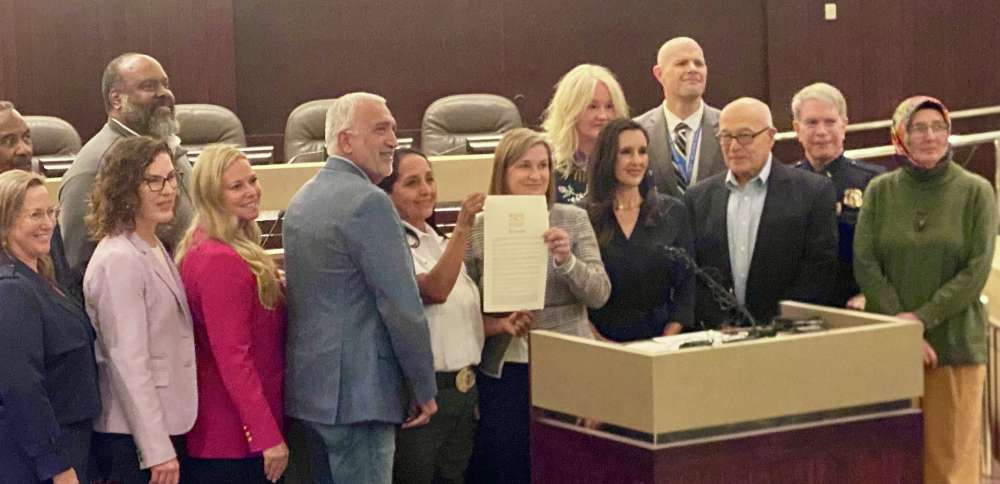
- Salt Lake County leaders signed a proclamation to combat a growing number of hate crimes.
- Jewish community leaders emphasize the impact of hate crimes on daily life.
- Officials urge reporting hate crimes, as underreporting remains a significant issue.
SALT LAKE CITY — The Jewish community makes up just half of 1% of Utah's entire population, according to Liz Paige, associate director of the United Jewish Federation of Utah.
But in 2025, Paige says 52% of the state's religiously motivated hate crimes targeted Jews.
The increase in crimes against the Jewish community in recent years has affected "how we gather, worship and educate our children," she said. Today, schools, summer camps and community events require extra security planning.
"Secure planning has become part of the everyday work of sustaining Jewish life in Utah and the country," Paige said. "Behind that work is the simple wish that parents can send their children to a religious school without fear, that people can enter a synagogue thinking about prayer rather than danger, that we can gather openly and joyfully as a Jewish community."
On Tuesday, Paige joined other community and Salt Lake County government leaders — including District Attorney Sim Gill, Mayor Jenny Wilson and Sheriff Rosie Rivera — to sign a proclamation committing to encourage understanding and empathy in the county and to take action against hate.
It's the second year in a row that county leaders have gathered to sign a proclamation to kick off United Against Hate Week.
"Hate crimes around the country are increasing, and … it is one of the most underreported crimes," Gill said. "And let's not kid ourselves that this is something that happens somewhere else."
In just the past six months, Gill said his office has filed charges against a man who allegedly said he "couldn't wait to kill a gay person," and in a separate case against a man who allegedly stabbed a worker at Valley Fair Mall because of the employee's religious beliefs while allegedly stating that he wanted to be a "catalyst so people would rid the country of Muslims."
No one should have to worry about being threatened, harassed or targeted simply because of who they are.
–Sheriff Rosie Rivera
As part of the proclamation read by Wilson and others, the county noted that "we live in a time of accelerating hate crime." But "the way we treat other people matters," Wilson read. County leaders are pledging to help promote a safe, compassionate and welcoming community.
While most violent hate crimes are reported, part of the problem, the group said, is that some have learned to live with the smaller transgressions of hate.
"We must also address the culture that allows hate to take root. We need a cultural recalibration. A renewed commitment to one another and to treat others as we want to be treated," Paige said. "We cannot allow harassments, threats or violence to become so familiar that we accept them as part of everyday life."
The group encouraged community members to report all incidents of hate crime to law enforcement.
"No one should have to worry about being threatened, harassed or targeted simply because of who they are," Rivera said. "We can't solve these types of crimes unless somebody reports them and cooperates with us … We don't want to just know about it; we want to be able to do something about it."
Jay Jacobson, chairman of the group Community Partners Against Hate, says even though the number of hate crimes being reported is the highest in decades, the Department of Justice believes the actual number of hate crimes being committed is still 25 to 50 times higher.
"Some of our partners have been known to say, 'This is the place.' All of our partners say, 'This is our place.' We'd like everyone in Utah to be able to say, 'This is no place for hate,'" he said.