'%3e%3cpath%20d='M34.1406%205.85938C30.3906%202.10547%2025.3047%200%2020%200C14.6953%200%209.60938%202.10547%205.85938%205.85938C2.10938%209.61328%200%2014.6953%200%2020C0%2025.3047%202.10547%2030.3906%205.85938%2034.1406C9.61328%2037.8906%2014.6953%2040%2020%2040C25.3047%2040%2030.3906%2037.8945%2034.1406%2034.1406C37.8906%2030.3906%2040%2025.3047%2040%2020C40%2014.6953%2037.8945%209.60938%2034.1406%205.85938ZM37.0117%2023.543H31.1602V13.5391H27.6328V19.9414C28.1211%2020.6914%2028.3711%2021.582%2028.3711%2022.5625V22.625C28.3711%2023.668%2028.1172%2024.6055%2027.6328%2025.4297V26.6094H36.082C33.4883%2032.9375%2027.2891%2037.3789%2020.0039%2037.3789C10.3711%2037.3789%202.62109%2029.6289%202.62109%2020C2.62109%2010.3711%2010.3711%202.62109%2020%202.62109C29.6289%202.62109%2037.3789%2010.3711%2037.3789%2020C37.3789%2021.1484%2037.2617%2022.2656%2037.0508%2023.3477C37.0391%2023.4141%2037.0234%2023.4766%2037.0117%2023.543Z'%20fill='white'/%3e%3cpath%20d='M22.3086%2018.5352C20.4336%2018.125%2019.9531%2017.8398%2019.9766%2017.1836V17.1406C19.9766%2016.6992%2020.3477%2016.2148%2021.4023%2016.2148C22.582%2016.2148%2023.8867%2016.6797%2025.0781%2017.4766L26.8516%2015.0195C25.4453%2013.8906%2023.707%2013.3398%2021.5547%2013.3398C18.5195%2013.3398%2016.4375%2015%2016.4063%2017.4766V17.5352C16.3633%2020.2617%2018.5859%2020.9805%2021.293%2021.6016C23.0391%2021.9766%2023.5703%2022.3164%2023.5703%2022.9609L23.5469%2022.9766C23.5469%2023.3906%2023.2578%2023.7031%2022.7852%2023.8359C22.5742%2023.9062%2022.1289%2023.9727%2021.5156%2023.9727C20.7617%2023.9727%2019.7539%2023.8633%2018.6328%2023.4844C18.0898%2023.2891%2017.4727%2023.0039%2016.8047%2022.6133L20.1406%2026.625C20.2813%2026.6602%2021.0977%2026.8516%2021.7734%2026.8516C25.0039%2026.8516%2027.0859%2025.2461%2027.1094%2022.6328V22.5703C27.1602%2020.1133%2025.2148%2019.1719%2022.3086%2018.5352Z'%20fill='white'/%3e%3cpath%20d='M5.24219%2013.5664V26.6133H8.75391V23.7578L10.2969%2021.9531L14.2031%2026.6133H18.3867L12.3555%2019.5195L17.4023%2013.5664H13.4531L8.75391%2019.0586V13.5664H5.24219Z'%20fill='white'/%3e%3c/g%3e%3cdefs%3e%3cclipPath%20id='clip0_97_2430'%3e%3crect%20width='40'%20height='40'%20fill='white'/%3e%3c/clipPath%3e%3c/defs%3e%3c/svg%3e)




- Salt Lake City officials emphasize protective orders as key tools against domestic violence.
- Approximately 94% of Utah protective order recipients report no further violence in a year.
- Salt Lake County District Attorney Sim Gill calls for uniform domestic violence investigation standards across Utah law enforcement.
SALT LAKE CITY — The biggest fear Salt Lake City police hear about protective orders is: "It's just a piece of paper."
"'How is this going to protect me? How is this going to make me feel better?'" are some of the concerns that Sgt. Liz Johnson, head of the department's domestic violence unit, and her team hear when advising victims of domestic violence to obtain a protective order.
But Johnson stresses, "A protective order is a tool for law enforcement."
Stewart Ralphs, executive director of the Legal Aid Society of Salt Lake, calls civil protective orders "highly effective," noting that about 94% of people who obtained a protective order in Utah reported no additional incidents of violence against themselves or family members one year later.
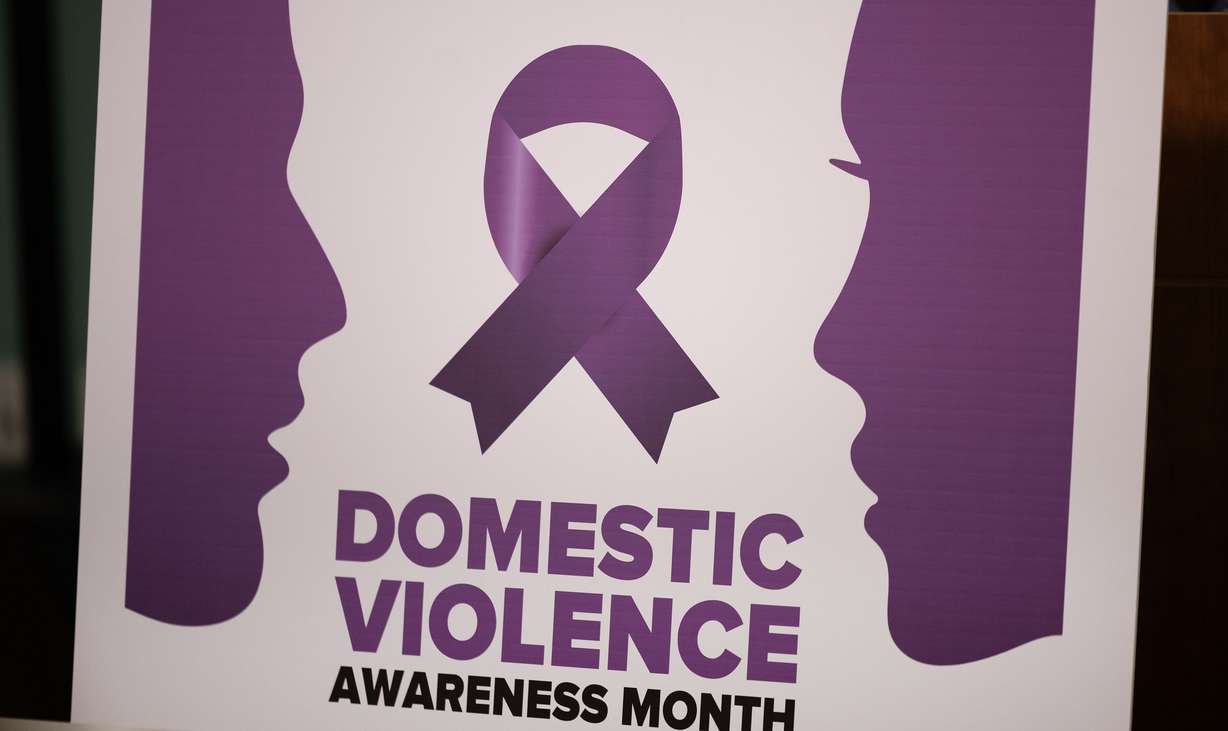
Ralphs and Johnson joined Salt Lake County District Attorney Sim Gill Thursday, the first day of October, to mark Domestic Violence Awareness Month. This year, Gill focused on protective orders: the type that are filed as part of criminal proceedings and civil protective orders for those who are experiencing domestic violence but may not have a criminal case.
Approximately 4,000 purple flags were planted in the parkway in front of the Salt Lake County District Attorney's Office Building on Thursday to represent the number of domestic violence cases the office screened last year.
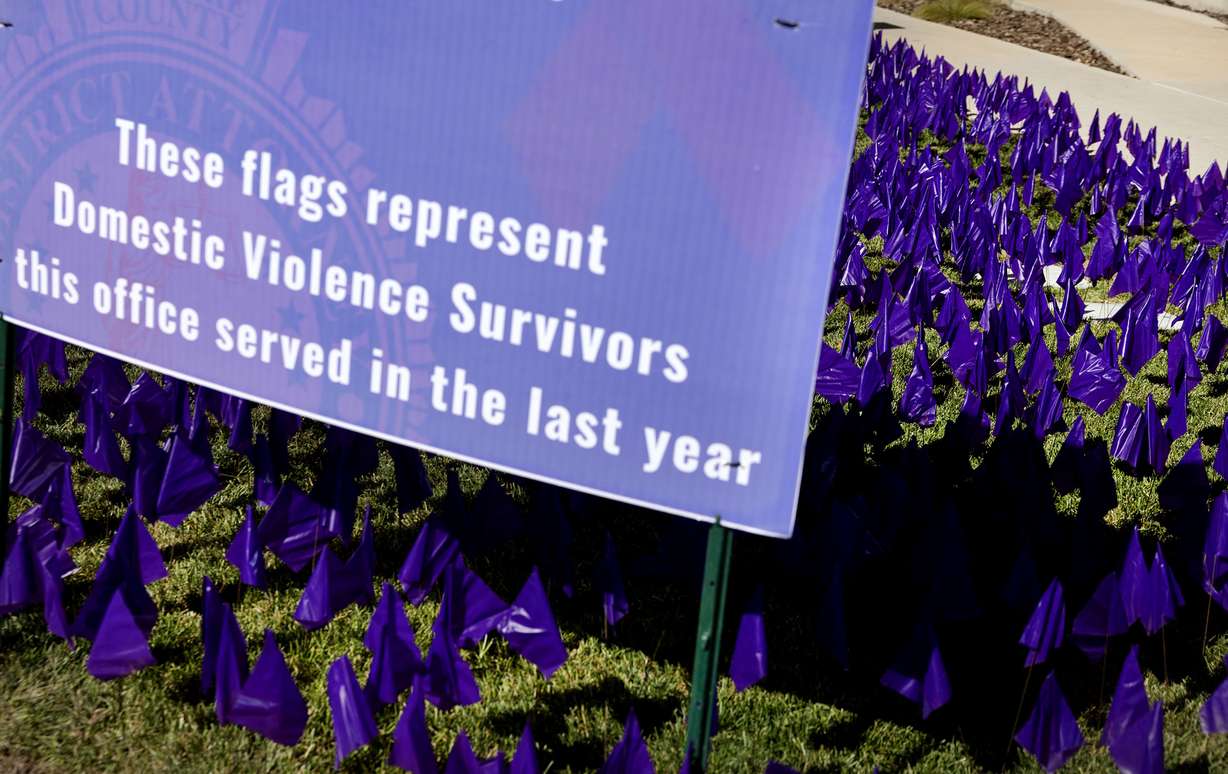
"The bitter truth is, this is ... an offense that is poorly reported and often underreported. Unfortunately, I think the reality is far more sobering ... it's much more than (4,000 cases)," Gill said.
According to national statistics, approximately 1 in 3 women and 1 in 6 men will experience sexual or physical violence during their lifetime or be stalked by an intimate partner, Gill said. He said 1 in 5 murders are domestic violence-related and intimate partner violence affects 20 people in the U.S. every minute.
A protective order allows police to intervene and gives officers legal authority to remove a person from a situation, Johnson said. It also puts the person served with the order on notice that further actions will have consequences, Gill added.
But it's often the 6% of people who "do not get the message" and ignore a protective order who make headlines, he admitted. That's why Gill says a community effort is needed not only to stop reoffenders, but to try and prevent domestic violence from happening in the first place.
"No one individual, no one individual organization, no one individual will be able to address this and solve it. It requires all of our collective effort," he said.
"I didn't know if I would be here"
Shae Thompson is a survivor of domestic violence and was asked to talk on Thursday about her story.
"There was a time I didn't know if I would be here at all," she said.
Thompson says people often ask, "Why didn't you leave?" or "Why didn't you say something?"
She said it was power, manipulation, control and grooming by her ex-boyfriend that prevented her from leaving. And even when she called police and showed them her injuries — including taking off her wig to show officers that nearly all of her hair had been ripped out — she was told that because the abuse didn't happen that same day, there wasn't much they could do.
"When the officer drove away, I was still unsafe. That's where the system failed me in the moment," she said.
More than once, she and her former boyfriend were separated for the evening by police, but he'd return the next day. She said that because of the embarrassment and shame she felt, she never "came forward."
But in 2024, Thompson got a protective order. She says she also got a judge "who believed in me" as well as a strong victim's advocate. Eventually, the boyfriend was charged in two cases with 30 domestic violence-related crimes dating back a couple of years. He was convicted earlier this year.
For too long, Thompson says she was made to feel small. Finding support matters, she said. Asking someone why they're still in a relationship doesn't help.
Now, she wants other victims of domestic violence to know there is light at the end of the tunnel, "even when you can't see it."
"Violence is never OK in a relationship, and it's not your fault," Thompson said.
She said she would like to see police receive more training on how to recognize manipulation and control in domestic violence situations, and not just look for physical injuries.
DUI investigations more uniform than DV
On Thursday, Gill called on Utah lawmakers to come up with a uniform system for all law enforcement agencies statewide on how domestic violence crimes are investigated.
"Did you know there is more consistency in investigating a DUI in the state of Utah than there is in intimate partner violence (investigation)?" he said.
A couple of years ago, a law was passed requiring all Utah police agencies to conduct a standardized Lethality Assessment when responding to domestic violence-related calls. Gill says a baseline domestic violence investigation should be the next step.
"Justice is the accident of geography, and it should not be," he said, noting that some agencies are progressing faster at improving domestic violence investigations than others.
He also hopes that, as a community, efforts will be made to prevent domestic violence from happening in the first place.
"So we are addressing that root cause and we're coming up with tools to respond after the fact. But the upstream impact is a responsibility that all of us own. It starts in grade school. You don't pull on Sally's pigtails. It's how we raise our families. This is learned behavior (that is) sometimes passed intergenerationally within families," he said.
Domestic violence is a learned behavior, Gill said, which "we can impact" but only with a community effort.
Domestic violence resources
Help for people in abusive relationships can be found by contacting:
- Utah Domestic Violence Coalition: Utah's confidential statewide, 24-hour domestic violence hotline at 1-800-897-LINK (5465)
- YWCA Utah Survivor Services: 801-537-8600
- Utah's statewide child abuse and neglect hotline: 1-855-323-DCFS (3237)
- National Domestic Violence Hotline: 1-800-799-7233