'%3e%3cpath%20d='M34.1406%205.85938C30.3906%202.10547%2025.3047%200%2020%200C14.6953%200%209.60938%202.10547%205.85938%205.85938C2.10938%209.61328%200%2014.6953%200%2020C0%2025.3047%202.10547%2030.3906%205.85938%2034.1406C9.61328%2037.8906%2014.6953%2040%2020%2040C25.3047%2040%2030.3906%2037.8945%2034.1406%2034.1406C37.8906%2030.3906%2040%2025.3047%2040%2020C40%2014.6953%2037.8945%209.60938%2034.1406%205.85938ZM37.0117%2023.543H31.1602V13.5391H27.6328V19.9414C28.1211%2020.6914%2028.3711%2021.582%2028.3711%2022.5625V22.625C28.3711%2023.668%2028.1172%2024.6055%2027.6328%2025.4297V26.6094H36.082C33.4883%2032.9375%2027.2891%2037.3789%2020.0039%2037.3789C10.3711%2037.3789%202.62109%2029.6289%202.62109%2020C2.62109%2010.3711%2010.3711%202.62109%2020%202.62109C29.6289%202.62109%2037.3789%2010.3711%2037.3789%2020C37.3789%2021.1484%2037.2617%2022.2656%2037.0508%2023.3477C37.0391%2023.4141%2037.0234%2023.4766%2037.0117%2023.543Z'%20fill='white'/%3e%3cpath%20d='M22.3086%2018.5352C20.4336%2018.125%2019.9531%2017.8398%2019.9766%2017.1836V17.1406C19.9766%2016.6992%2020.3477%2016.2148%2021.4023%2016.2148C22.582%2016.2148%2023.8867%2016.6797%2025.0781%2017.4766L26.8516%2015.0195C25.4453%2013.8906%2023.707%2013.3398%2021.5547%2013.3398C18.5195%2013.3398%2016.4375%2015%2016.4063%2017.4766V17.5352C16.3633%2020.2617%2018.5859%2020.9805%2021.293%2021.6016C23.0391%2021.9766%2023.5703%2022.3164%2023.5703%2022.9609L23.5469%2022.9766C23.5469%2023.3906%2023.2578%2023.7031%2022.7852%2023.8359C22.5742%2023.9062%2022.1289%2023.9727%2021.5156%2023.9727C20.7617%2023.9727%2019.7539%2023.8633%2018.6328%2023.4844C18.0898%2023.2891%2017.4727%2023.0039%2016.8047%2022.6133L20.1406%2026.625C20.2813%2026.6602%2021.0977%2026.8516%2021.7734%2026.8516C25.0039%2026.8516%2027.0859%2025.2461%2027.1094%2022.6328V22.5703C27.1602%2020.1133%2025.2148%2019.1719%2022.3086%2018.5352Z'%20fill='white'/%3e%3cpath%20d='M5.24219%2013.5664V26.6133H8.75391V23.7578L10.2969%2021.9531L14.2031%2026.6133H18.3867L12.3555%2019.5195L17.4023%2013.5664H13.4531L8.75391%2019.0586V13.5664H5.24219Z'%20fill='white'/%3e%3c/g%3e%3cdefs%3e%3cclipPath%20id='clip0_97_2430'%3e%3crect%20width='40'%20height='40'%20fill='white'/%3e%3c/clipPath%3e%3c/defs%3e%3c/svg%3e)


Estimated read time: 5-6 minutes
This archived news story is available only for your personal, non-commercial use. Information in the story may be outdated or superseded by additional information. Reading or replaying the story in its archived form does not constitute a republication of the story.
SALT LAKE CITY — From an outsider's point-of-view, Utah’s offense appears to always take a back seat to that of the team’s stout, NFL-rich defense.
At Utah, it’s defense U. and a side of the football program that has carried the team for much of Kyle Whittingham’s tenure as head coach. As long as the offense does just enough, the defense will keep the Utes close in any game. And for the most part, it has not been a horrible strategy considering how successful the defense has been over the years.
The defense, again, is expected to have another strong season, particularly with the team’s defensive line projected as a top five line in the country. But the 2016 season has the makings for a different look on offense, or at least it’s a possibility now that Utah has been in the Pac-12 for several years and has had time to recruit the talent needed to compete.
Although the offense is not set in stone, only a few days into fall camp, Whittingham and his players have given some indication as to how this year’s offense is expected to look.
To start, believing the offense will have some sort of rebirth and become an offensive juggernaut in the Pac-12 is a misnomer. Utah’s offense will always play second fiddle to its powerhouse defense, and there’s nothing wrong with that. But the gap could become smaller with a different look at nearly every position on offense.
Passing Game
Former Ute Travis Wilson was Utah’s first four-year starter at quarterback in school history; that’s saying something, despite opinions of his mettle as the team’s signal caller. Under Wilson, the offense was consistent in what it did — for good and for bad — and didn’t offer much variance. Occasionally, an Oregon game circa 2015 came along, but that was more of an outlier than many would like to believe.
However, Wilson managed the offense well and did what he was asked. Utah, though, can now take its next step in moving forward and competing for a divisional title. The program has what appears to be one of many quarterbacks ready to take the next step in running an offense more closely aligned to its Pac-12 counterparts.
It’s still too early to project a starting quarterback, particularly with Whittingham reiterating the fact there has been “no separation” between Brandon Cox, Troy Williams and Tyler Huntley in the first couple of days of camp. But for whomever starts, it’s clear that Whittingham wants a more balanced offense than in year’s past, particularly with one that exhibits more of a passing threat.
The basic tenet of the spread offense that Utah likes to run is based on the simple fact the offense is supposed to actually spread the field with its skills players. This is only accomplished by having several targets available for the quarterback to distribute the ball to. In Utah’s case, that’s two wide receivers, a slot receiver and a tight end. Occasionally there is a backfield option for a running back-drawn play thrown into the receiving mix.
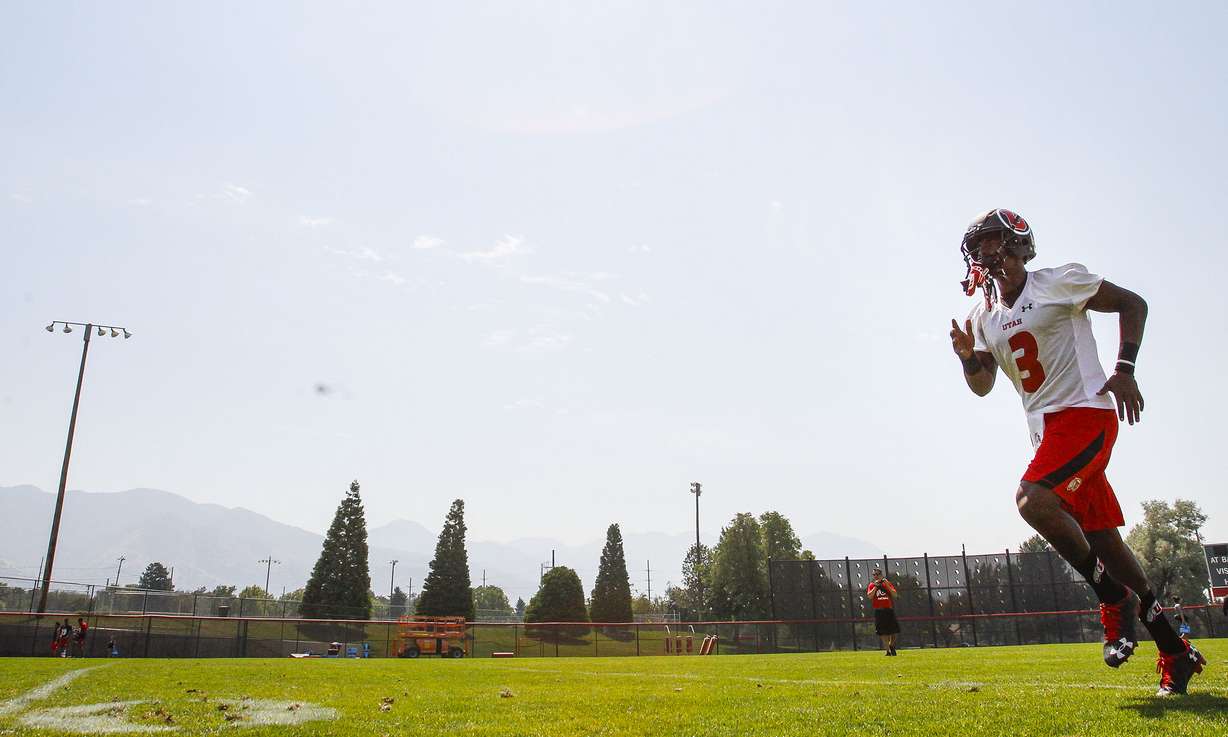
Ideally, Utah could use guys like Kyle Fulks for some speed, Tim Patrick and Tyrone Smith as the “jump ball” specialists and Siale Fakailoatonga as a quick slant option to move the chains. Throw in Joe Williams as an optional receiver and the offense has done its job in the receiving game to force defenses to adapt quickly and spread the field.
Patrick said Whittingham’s expectations for the season is that of a 50/50 pass-run approach, with the quarterback taking more shots down field. However, if the passing game is effective, there’s no reason to go away from it for the sake of a ground game.
Although the goal of a more balanced offense sounds great in theory, it has yet to be put into practice with a group of relatively inexperienced receivers. Much of this facet of the game is yet to be determined but could make Utah a Pac-12 championship contender if adopted properly.
“We can’t be at the end of the Pac-12 in passing. We have to be in that top five,” Patrick said. “That’s the goal for the team: we have to be in the top five of the Pac-12 if we want to win a championship.”
Ground Game
The ground game has been Utah’s bread and butter on offense. Last season, star running back Devontae Booker was essentially Utah’s game plan as it went to the ground 62 percent of all downs. Booker was effective, but a very one-dimensional aspect to the team. Opposing teams didn’t need to scout Utah’s offense much because it was more often than not going to Booker.
Looking forward to the 50/50 balanced approach, Whittingham said he expects projected starter Joe Williams to get approximately 15-20 carries per game, with Troy McCormick or an assortment of running backs to make up the remainder of the workload.
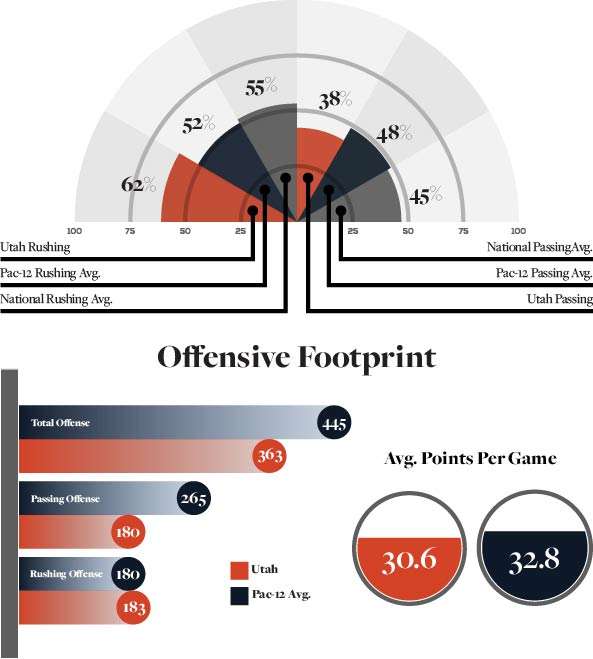
Given that Utah had an average of 76 downs per game last season, Utah will feature multiple backs performing an assortment of duties — two-back sets, read options, sweeps, reverses, etc. — to make up approximately 38 running plays per game. In essence, it opens up the playbook for a number of running backs to have an impact on the team, with Williams leading the charge as the primary back.
“We’re not going to have the one-guy workload like Devontae had; that’s not going to happen, I can just about guarantee that,” Whittingham said. “Joe will be the primary ball carrier and then we’ll spread those other reps around.”
Although Booker was a proven commodity in the backfield last season, it limited Utah’s options in what it could do offensively. Moving forward, Utah can become an unpredictable threat at running back if Williams, McCormick, et al. step up and prove their talent. With the depth at running back, opposing teams would have a hard time scouting individuals and would be forced to identify the scheme more than the actual talent behind the quarterback. However, Williams and McCormick remain the two favorites to get the bulk of the workload.
“We think we’ve really helped ourselves with the running back position from a depth standpoint,” Whittingham said. “Obviously losing Booker is huge, but we think we have one of the better groups we’ve had than we have in several years, in total.”