
- Salt Lake City's $5.1 billion airport project concluded with 94 gates and over 100 concessions.
- The airport, completed ahead of schedule and under budget, is highly acclaimed.
- Future plans include runway extension and Concourse C, contingent on passenger growth.
SALT LAKE CITY — Several thoughts came to Bill Wyatt's mind as he finally saw the glass windows at the eastern end of the Salt Lake City International Airport's Concourse B for the first time Tuesday morning.
Wyatt, the airport's director, thought of the contractors and construction workers who have worked diligently over the past 12 years to complete the $5.1 billion full buildout of the brand-new airport, many of whom he may never see again as they move on to the next new project.
Then he thought of the legacy left by everyone who planned or built the project, not just over the past decade, but over the past 30 years.
"It's a great feeling because all of us — the thousands of people who have been part of this — are going to have their fingerprints on this facility, which will be here for generations and generations to come," he said, as passengers sifted through to eight new gates behind him.
Salt Lake City airport's initial buildout came to an end this week, as the first flight out of the last construction phase took off Monday night and the final new concessions opened Tuesday morning.
City leaders and Delta Air Lines officials joined airport employees in commemorating the moment with one last ribbon-cutting, celebrating the 94 gates and more than 100 concession areas within the complex.
The moment marked the end of a long journey spanning several decades.
Planning for the new Salt Lake City airport began in the mid-1990s, but a few unexpected disruptions — mainly 9/11 and the 2008 financial crisis — delayed the beginning of construction by about 20 years.
Six years of construction later, the airport's first gates finally opened in September 2020, in the middle of a global pandemic. Extra gates have opened in phases over the past six years, leading up to this week.
The project was completed ahead of schedule and under budget, Wyatt noted. It was also named as one of the best airports in North America as part of the 2025 ASQ Customer Experience Awards.
"This airport is really, truly head and shoulders above," said Salt Lake City Mayor Erin Mendenhall, before thanking all her predecessors who helped with the vision. "This airport is for all of you: Salt Lake City, Utah, the entire region and now the world. We are so happy to open it up to you, finally (and) totally."
The end?
However, "the end" in this story comes with a question mark rather than a period.
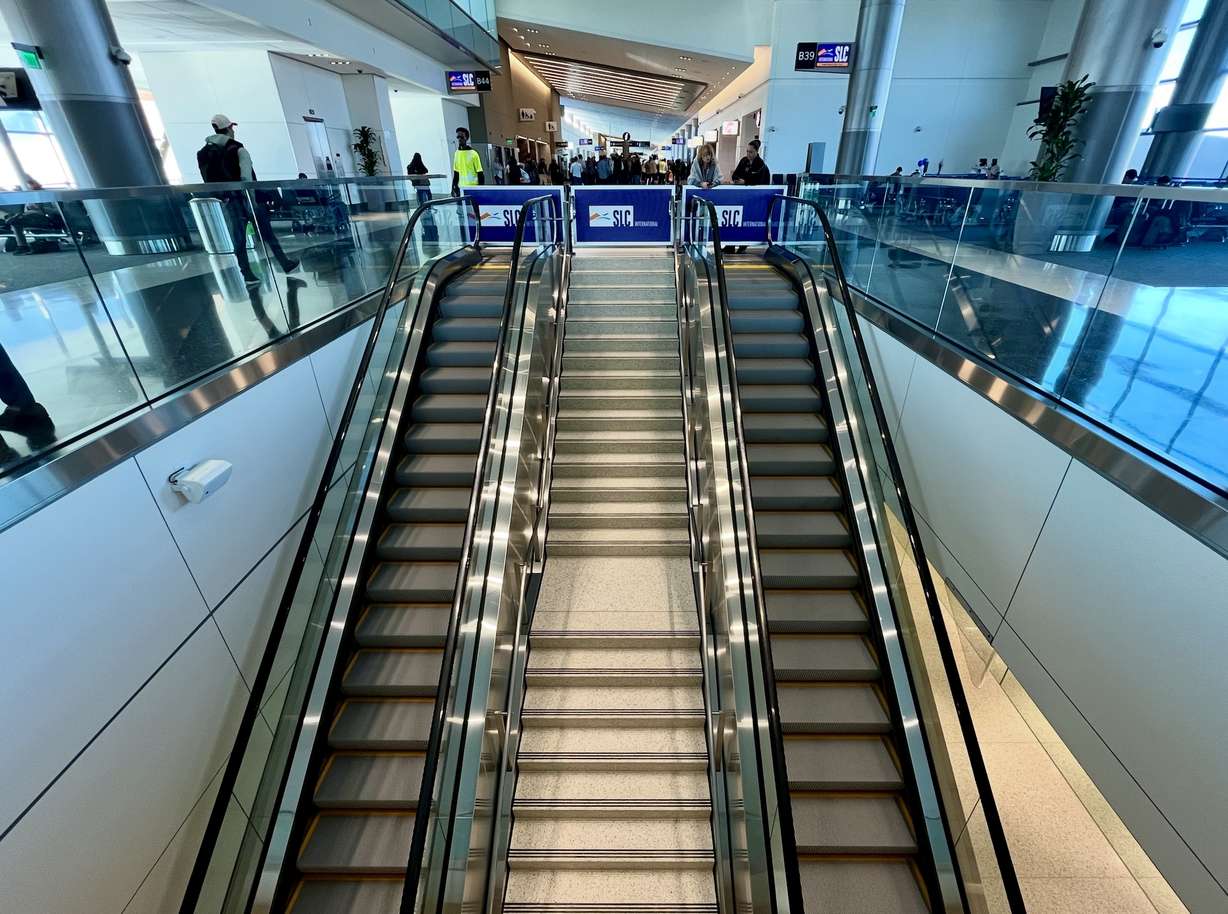
Passengers might notice a mysterious escalator between B41 and B46 when they arrive at the end of the airport. It's currently blocked off, but it hints at the next phase of growth hidden in plain sight — while other hints are just out of view.
The mysterious escalator leads to the outside of the concourse, allowing airlines to operate without a jet bridge. Passengers use a bus that goes to a parked plane, boarding through stairs rolled up to it, Wyatt explained.
"It's a way for, for example, a new airline to test Salt Lake without having to make a huge investment, and see if this is a place they want to be," he told KSL. "It is just a little added piece of flexibility in service, as well."
It isn't in use now, but he believes it could be requested at some point over the next few years.
Airport officials are also planning to extend the runway to handle recent challenges airlines have faced. During hot days, airlines often have to ask passengers to board another flight or adjust fuel to address the heat density factor, which makes it less profitable and worthwhile for airlines to fly out of the airport.
The goal is to complete that extension before the 2034 Winter Olympics, which could help bring in more international airlines.
Salt Lake City's future plans also call for a Concourse C at some point. A somewhat secret tunnel exists next to the airport's "river tunnel" that has space for a future tram that will eventually link up three concourses when that's built.
When it is built is to be determined.
The airport recorded nearly 28.5 million passengers during the 2026 fiscal year, which wrapped up on June 30. That's a modest 1.2% increase from the previous fiscal year, but Wyatt estimates that the trigger point to begin construction won't be until volumes reach 34 million to 35 million.
Projecting when that will happen is difficult to tell; however, as evidenced by the delays between planning the new airport and its completion 30 years later.
If the local economy remains strong and other economic factors, like high fuel prices—one of the biggest challenges at the moment—settle, it could reach the trigger point in the 2030s. If not, it could take longer.
"We don't really have control over those things," Wyatt said.
Thus, for now, the primary focus is operating an airport that's now complete, while watching metrics to see when the time is right to build again.