'%3e%3cpath%20d='M34.1406%205.85938C30.3906%202.10547%2025.3047%200%2020%200C14.6953%200%209.60938%202.10547%205.85938%205.85938C2.10938%209.61328%200%2014.6953%200%2020C0%2025.3047%202.10547%2030.3906%205.85938%2034.1406C9.61328%2037.8906%2014.6953%2040%2020%2040C25.3047%2040%2030.3906%2037.8945%2034.1406%2034.1406C37.8906%2030.3906%2040%2025.3047%2040%2020C40%2014.6953%2037.8945%209.60938%2034.1406%205.85938ZM37.0117%2023.543H31.1602V13.5391H27.6328V19.9414C28.1211%2020.6914%2028.3711%2021.582%2028.3711%2022.5625V22.625C28.3711%2023.668%2028.1172%2024.6055%2027.6328%2025.4297V26.6094H36.082C33.4883%2032.9375%2027.2891%2037.3789%2020.0039%2037.3789C10.3711%2037.3789%202.62109%2029.6289%202.62109%2020C2.62109%2010.3711%2010.3711%202.62109%2020%202.62109C29.6289%202.62109%2037.3789%2010.3711%2037.3789%2020C37.3789%2021.1484%2037.2617%2022.2656%2037.0508%2023.3477C37.0391%2023.4141%2037.0234%2023.4766%2037.0117%2023.543Z'%20fill='white'/%3e%3cpath%20d='M22.3086%2018.5352C20.4336%2018.125%2019.9531%2017.8398%2019.9766%2017.1836V17.1406C19.9766%2016.6992%2020.3477%2016.2148%2021.4023%2016.2148C22.582%2016.2148%2023.8867%2016.6797%2025.0781%2017.4766L26.8516%2015.0195C25.4453%2013.8906%2023.707%2013.3398%2021.5547%2013.3398C18.5195%2013.3398%2016.4375%2015%2016.4063%2017.4766V17.5352C16.3633%2020.2617%2018.5859%2020.9805%2021.293%2021.6016C23.0391%2021.9766%2023.5703%2022.3164%2023.5703%2022.9609L23.5469%2022.9766C23.5469%2023.3906%2023.2578%2023.7031%2022.7852%2023.8359C22.5742%2023.9062%2022.1289%2023.9727%2021.5156%2023.9727C20.7617%2023.9727%2019.7539%2023.8633%2018.6328%2023.4844C18.0898%2023.2891%2017.4727%2023.0039%2016.8047%2022.6133L20.1406%2026.625C20.2813%2026.6602%2021.0977%2026.8516%2021.7734%2026.8516C25.0039%2026.8516%2027.0859%2025.2461%2027.1094%2022.6328V22.5703C27.1602%2020.1133%2025.2148%2019.1719%2022.3086%2018.5352Z'%20fill='white'/%3e%3cpath%20d='M5.24219%2013.5664V26.6133H8.75391V23.7578L10.2969%2021.9531L14.2031%2026.6133H18.3867L12.3555%2019.5195L17.4023%2013.5664H13.4531L8.75391%2019.0586V13.5664H5.24219Z'%20fill='white'/%3e%3c/g%3e%3cdefs%3e%3cclipPath%20id='clip0_97_2430'%3e%3crect%20width='40'%20height='40'%20fill='white'/%3e%3c/clipPath%3e%3c/defs%3e%3c/svg%3e)


- Vernal residents face steep water bill hikes due to drought-induced rate increases.
- Some bills rose over 500%, causing financial strain for fixed-income seniors.
- The higher costs have forced difficult choices, while other districts' rates remain lower.
VERNAL — Some Vernal residents say they are struggling to afford dramatically higher water bills after the Ashley Valley Water & Sewer Improvement District implemented steep rate increases aimed at conserving water during what officials describe as an unprecedented drought.
For some customers, the increases have been staggering.
Toni Graham said her parents' monthly water bill jumped from about $151.66 for 61,000 gallons of water to nearly $945.50 for 61,000 gallons of water in one month, more than a 500% increase.
"Ashley Valley Water — drastic! It's not even double or triple," Graham said.
She said the increase is especially difficult because her parents are retired.
"They're elderly; they're on a fixed income. They can't afford a water bill that's $1,000 a month," Graham said. "It's just something they can't sustain."
Stephanie Johnson said her family cut its water use in half compared with last year, but their bill still went up.
"We used half as much water this year as last year and our water bill is almost double what it was last year," Johnson said.
Johnson said her family used about 23,000 gallons of water, resulting in a bill of approximately $210. Last year, Johnson said her bill was $161 for 46,000 gallons.
The higher costs have forced difficult choices.
"We can't afford the water," Johnson said. "It's choosing between eating food and taking a bath, and that's really hard."
She said the family's efforts to conserve have taken a visible toll on their property.
"This is our plum tree that's completely dead," Johnson said, pulling at the dried branches.
Candace Hall said she has also significantly reduced her water use, but worries the restrictions could cost her mature trees.
"It's just sad," Hall said. "Scary, because I don't want to lose them."
Hall said she understands the need for conservation but believes the financial burden has become too great.
"We're senior citizens, we're on a fixed income and it's taking a huge bite," Hall said.
Hall said she actually received a discount on her bill because she has reduced her usage by at least 20%, but after seeing the toll on her property, she is increasing her watering to save her trees.
Hall also questioned why neighboring water providers have not imposed similarly steep increases. Water rates for Maeser Water Improvement District and Vernal remain much lower.
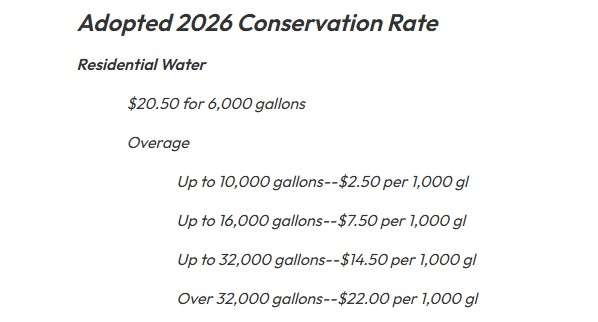
For example, under the Ashley District's adopted 2026 water conservation rate, more than 32,000 gallons of water at a residential rate are charged at $22.00 per 1,000 gallons. Maeser's rate ranges between $2.26 and $4.16 per 1000 gallons for anything above 7,000 gallons, with a $32.50 base fee. Vernal's fee is $2.83 per 1,000 gallons with a minimum fee of $43.80.
"I understand we need to cut back, and I'm willing to do that, but when I hear that the other districts in town aren't putting such a huge penalty on people, that upsets me," Hall said.
"Some people are getting higher water bills than their house payments are, and that's not right," she added.
On April 29, the Ashley Valley Water District recently adopted a tiered rate structure that sharply increases the cost of water for customers with higher usage.
Ashley Valley Water district manager Ryan Goodrich said several residents attended the public meeting and supported a new rate structure that penalizes the biggest water users.
"The rate structure is designed to reward those who conserve by lowering the base rate, is designed to be temporary (expires at the end of October 2026 as water supply allows), and funds from rates will go back into the system to either purchase additional water rights/shares, or improve the existing distribution systems," according to the district's website.
Under the new rates, customers pay $20.50 for 6,000 gallons, then $2.50 per 1,000 gallons for the first 10,000 gallons used. Once usage exceeds 32,000 gallons, the rate jumps to $22 per 1,000 gallons.
According to the district, a customer using 32,000 gallons would now pay about $307.50, compared with roughly $86.40 under the normal rate structure.
District officials say the changes were necessary because the area is experiencing what they describe as "the worst water conditions in living memory." They said they are uncertain whether existing water supplies will last through October without significant reductions in consumption.
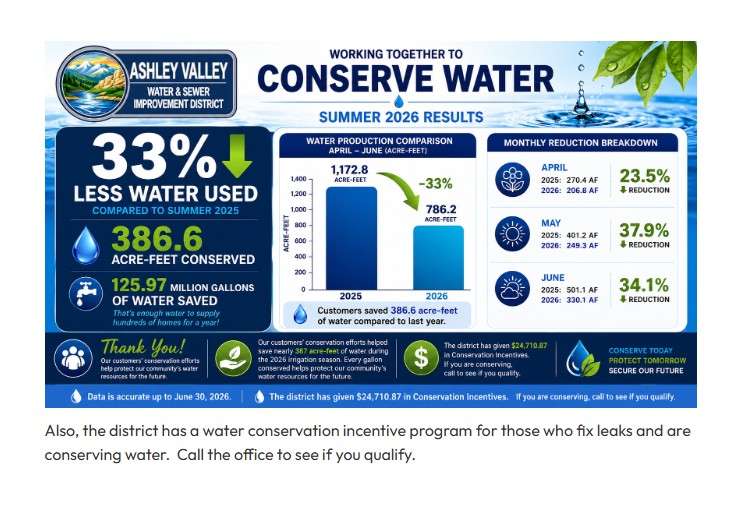
Goodrich said the higher rates appear to be achieving their intended goal. Water use this summer is down 33% compared with 2025.
He also said it is possible to water a quarter-acre with 3,000 gallons per month, and it will still survive.
"It won't be green, it won't be pretty, but it will survive," he said.
Still, there may be some relief ahead.
Goodrich said if conservation efforts continue to reduce demand, the district could rescind the higher conservation rate as early as August or September — sooner than originally anticipated on Oct. 31.
For more information, you can visit: https://www.ashleywatersewerut.gov/thank-you

Most recent Eastern Utah stories
Related topics
 Garna Mejia