'%3e%3cpath%20d='M34.1406%205.85938C30.3906%202.10547%2025.3047%200%2020%200C14.6953%200%209.60938%202.10547%205.85938%205.85938C2.10938%209.61328%200%2014.6953%200%2020C0%2025.3047%202.10547%2030.3906%205.85938%2034.1406C9.61328%2037.8906%2014.6953%2040%2020%2040C25.3047%2040%2030.3906%2037.8945%2034.1406%2034.1406C37.8906%2030.3906%2040%2025.3047%2040%2020C40%2014.6953%2037.8945%209.60938%2034.1406%205.85938ZM37.0117%2023.543H31.1602V13.5391H27.6328V19.9414C28.1211%2020.6914%2028.3711%2021.582%2028.3711%2022.5625V22.625C28.3711%2023.668%2028.1172%2024.6055%2027.6328%2025.4297V26.6094H36.082C33.4883%2032.9375%2027.2891%2037.3789%2020.0039%2037.3789C10.3711%2037.3789%202.62109%2029.6289%202.62109%2020C2.62109%2010.3711%2010.3711%202.62109%2020%202.62109C29.6289%202.62109%2037.3789%2010.3711%2037.3789%2020C37.3789%2021.1484%2037.2617%2022.2656%2037.0508%2023.3477C37.0391%2023.4141%2037.0234%2023.4766%2037.0117%2023.543Z'%20fill='white'/%3e%3cpath%20d='M22.3086%2018.5352C20.4336%2018.125%2019.9531%2017.8398%2019.9766%2017.1836V17.1406C19.9766%2016.6992%2020.3477%2016.2148%2021.4023%2016.2148C22.582%2016.2148%2023.8867%2016.6797%2025.0781%2017.4766L26.8516%2015.0195C25.4453%2013.8906%2023.707%2013.3398%2021.5547%2013.3398C18.5195%2013.3398%2016.4375%2015%2016.4063%2017.4766V17.5352C16.3633%2020.2617%2018.5859%2020.9805%2021.293%2021.6016C23.0391%2021.9766%2023.5703%2022.3164%2023.5703%2022.9609L23.5469%2022.9766C23.5469%2023.3906%2023.2578%2023.7031%2022.7852%2023.8359C22.5742%2023.9062%2022.1289%2023.9727%2021.5156%2023.9727C20.7617%2023.9727%2019.7539%2023.8633%2018.6328%2023.4844C18.0898%2023.2891%2017.4727%2023.0039%2016.8047%2022.6133L20.1406%2026.625C20.2813%2026.6602%2021.0977%2026.8516%2021.7734%2026.8516C25.0039%2026.8516%2027.0859%2025.2461%2027.1094%2022.6328V22.5703C27.1602%2020.1133%2025.2148%2019.1719%2022.3086%2018.5352Z'%20fill='white'/%3e%3cpath%20d='M5.24219%2013.5664V26.6133H8.75391V23.7578L10.2969%2021.9531L14.2031%2026.6133H18.3867L12.3555%2019.5195L17.4023%2013.5664H13.4531L8.75391%2019.0586V13.5664H5.24219Z'%20fill='white'/%3e%3c/g%3e%3cdefs%3e%3cclipPath%20id='clip0_97_2430'%3e%3crect%20width='40'%20height='40'%20fill='white'/%3e%3c/clipPath%3e%3c/defs%3e%3c/svg%3e)


Estimated read time: 3-4 minutes
This archived news story is available only for your personal, non-commercial use. Information in the story may be outdated or superseded by additional information. Reading or replaying the story in its archived form does not constitute a republication of the story.
SUZU, Japan — Japanese rescue workers and canine units searched urgently through rubble Wednesday ahead of predicted bitter cold and heavy rain in what the prime minister called a race against time after powerful earthquakes killed at least 73 people in western Japan.
Fifteen people were listed as officially missing and possibly trapped under collapsed buildings.
Ishikawa prefecture and nearby areas were shaken by more aftershocks on Wednesday, adding to the dozens that followed Monday's magnitude 7.6 temblor centered near Noto, about 185 miles from Tokyo on the opposite coast. The quake set off tsunami warnings, followed by waves measuring more than 3 feet in some places.
The first 72 hours are especially critical for rescues, experts say, because the prospects for survival greatly diminish after that.
"More than 40 hours have passed. This is a race against time, and I feel that we are at a critical moment," Prime Minister Fumio Kishida told reporters. "We have received reports many people are still waiting for rescue under collapsed buildings."
The narrow Noto Peninsula has added to the challenges in reaching some communities. Water, power and cellphone service were still down in some areas.
Naomi Gonno says she and her children got out of their house just as it came crashing down.
But her children were screaming "Granma," and Gonno saw that her mother was trapped under the smashed house, with only her hand visible. She was able to squeeze her way out through a tiny space, Gonno said.
"I can't believe we're still alive," she said. "We are living in fear."
Relief officials handed out water, blankets, food and other supplies. Search dogs joined military personnel and firefighters trying to find missing people, although the exact number is unclear.
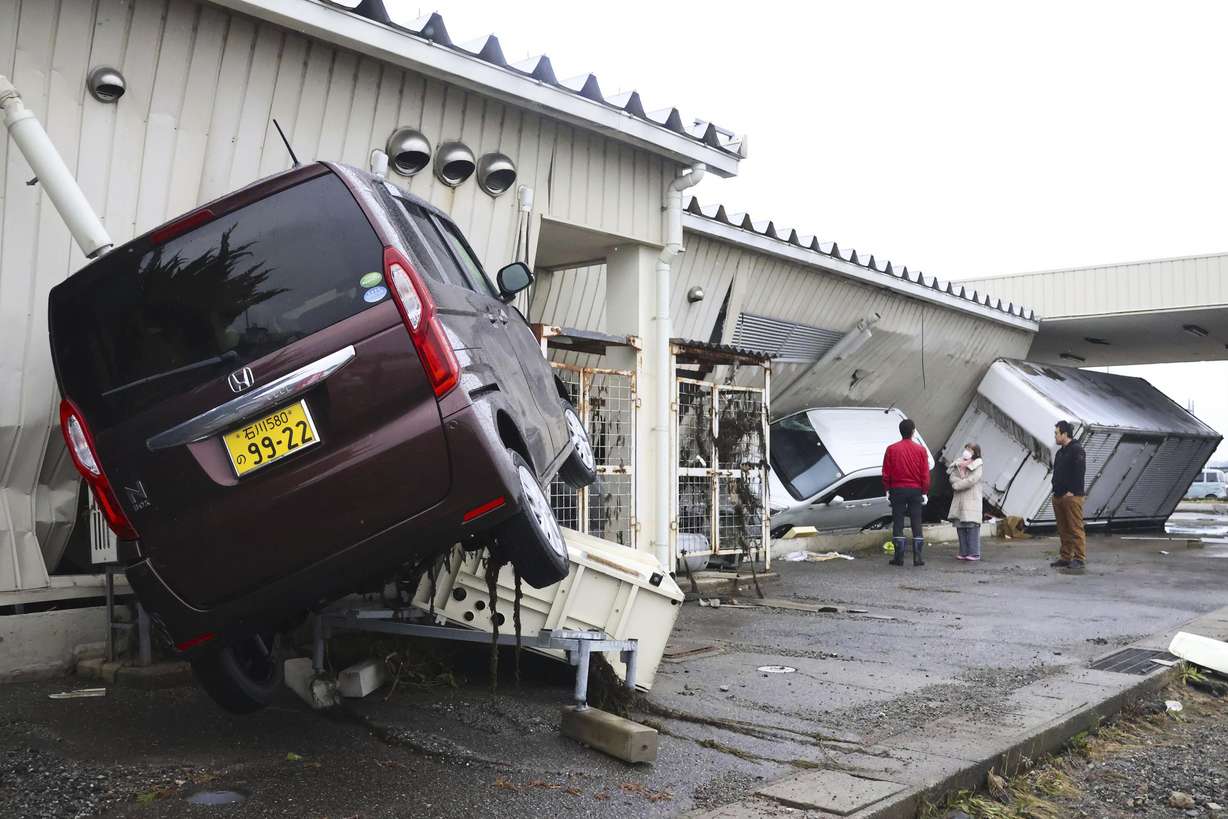
Weather forecasts warned of heavy rain in Ishikawa, leading to worries about landslides and further damage to half-crumbled homes. Temperatures were expected to drop to around 39 degrees Fahrenheit overnight.
Of the deaths, 39 were counted in Wajima city, while 23 people died in Suzu, according to Ishikawa prefectural authorities. The other deaths were reported in five neighboring towns.
More than 300 people have been injured, at least 25 of them seriously.
Nearly 33,000 people are staying at evacuation centers, and some said they were hungry and cold, unable to sleep and afraid.
When Monday's quake hit, Yasuo Kobatake ran out of his house with just one sock on. The shaking threw him to the ground, and a concrete wall came crashing down, barely missing him, he said.

He was eating only rice balls and a few sips of water in paper cups at the elementary school where he and others have been sheltering. They slept on cushions, with no blankets.
"It was so cold. I thought I'd freeze to death," he said.
In the aftermath of the quakes and tsunami, boats lay overturned in the sea, roads were blocked by mounds of dirt, and pillars and walls lay scattered from flattened homes. A large fire turned an entire section of Wajima city into ashes.
Officials warned that more major quakes could follow.
Takako Izumi, a disaster science professor at Tohoku University, said time is needed to figure out logistics because roads are often blocked after an earthquake, and large trucks can't get through to deliver aid.
If land routes aren't accessible, aid may have to be dropped from the sky or brought in by boat. The winter cold adds to health risks, and some people may still have not reached an evacuation center, she added.
"We need to accurately assess the damage first. And then a proper response can come, and what's needed can reach the right places," Izumi said.
Contributing: Haruka Nuga