'%3e%3cpath%20d='M34.1406%205.85938C30.3906%202.10547%2025.3047%200%2020%200C14.6953%200%209.60938%202.10547%205.85938%205.85938C2.10938%209.61328%200%2014.6953%200%2020C0%2025.3047%202.10547%2030.3906%205.85938%2034.1406C9.61328%2037.8906%2014.6953%2040%2020%2040C25.3047%2040%2030.3906%2037.8945%2034.1406%2034.1406C37.8906%2030.3906%2040%2025.3047%2040%2020C40%2014.6953%2037.8945%209.60938%2034.1406%205.85938ZM37.0117%2023.543H31.1602V13.5391H27.6328V19.9414C28.1211%2020.6914%2028.3711%2021.582%2028.3711%2022.5625V22.625C28.3711%2023.668%2028.1172%2024.6055%2027.6328%2025.4297V26.6094H36.082C33.4883%2032.9375%2027.2891%2037.3789%2020.0039%2037.3789C10.3711%2037.3789%202.62109%2029.6289%202.62109%2020C2.62109%2010.3711%2010.3711%202.62109%2020%202.62109C29.6289%202.62109%2037.3789%2010.3711%2037.3789%2020C37.3789%2021.1484%2037.2617%2022.2656%2037.0508%2023.3477C37.0391%2023.4141%2037.0234%2023.4766%2037.0117%2023.543Z'%20fill='white'/%3e%3cpath%20d='M22.3086%2018.5352C20.4336%2018.125%2019.9531%2017.8398%2019.9766%2017.1836V17.1406C19.9766%2016.6992%2020.3477%2016.2148%2021.4023%2016.2148C22.582%2016.2148%2023.8867%2016.6797%2025.0781%2017.4766L26.8516%2015.0195C25.4453%2013.8906%2023.707%2013.3398%2021.5547%2013.3398C18.5195%2013.3398%2016.4375%2015%2016.4063%2017.4766V17.5352C16.3633%2020.2617%2018.5859%2020.9805%2021.293%2021.6016C23.0391%2021.9766%2023.5703%2022.3164%2023.5703%2022.9609L23.5469%2022.9766C23.5469%2023.3906%2023.2578%2023.7031%2022.7852%2023.8359C22.5742%2023.9062%2022.1289%2023.9727%2021.5156%2023.9727C20.7617%2023.9727%2019.7539%2023.8633%2018.6328%2023.4844C18.0898%2023.2891%2017.4727%2023.0039%2016.8047%2022.6133L20.1406%2026.625C20.2813%2026.6602%2021.0977%2026.8516%2021.7734%2026.8516C25.0039%2026.8516%2027.0859%2025.2461%2027.1094%2022.6328V22.5703C27.1602%2020.1133%2025.2148%2019.1719%2022.3086%2018.5352Z'%20fill='white'/%3e%3cpath%20d='M5.24219%2013.5664V26.6133H8.75391V23.7578L10.2969%2021.9531L14.2031%2026.6133H18.3867L12.3555%2019.5195L17.4023%2013.5664H13.4531L8.75391%2019.0586V13.5664H5.24219Z'%20fill='white'/%3e%3c/g%3e%3cdefs%3e%3cclipPath%20id='clip0_97_2430'%3e%3crect%20width='40'%20height='40'%20fill='white'/%3e%3c/clipPath%3e%3c/defs%3e%3c/svg%3e)


Estimated read time: 6-7 minutes
KEY TAKEAWAYS
- The U.S. and Israel's conflict with Iran has intensified, with escalating attacks.
- Iran's President Pezeshkian apologized to Gulf nations, promising no strikes unless provoked.
- U.S. President Donald Trump has threatened to escalate the conflict.
WASHINGTON — It's been a week since the United States and Israel launched their war with Iran, sparking a wider conflict across the Middle East that the United Nations warns could spiral out of control.
Iran's President Masoud Pezeshkian delivered a remarkable televised address apologizing to neighboring Gulf nations and promising not to strike them – unless their territories are used to attack Iran. Saudi Arabia, Qatar, Bahrain and the United Arab Emirates saw fresh drone and missile attacks Saturday morning.
Meanwhile, U.S. President Donald Trump threatened to escalate the conflict, saying the U.S. will strike Iran "very hard."
Here's what you need to know.
What are the main headlines?
- Trump signals escalation: Trump wrote "today Iran will be hit very hard" in a Saturday morning post on Truth Social. He also indicated that Washington would widen its targets in the country, saying certain areas and groups of people are now at risk of "complete destruction and certain death."
- Iranian president's address: Pezeshkian gave a defiant speech on state media earlier Saturday, saying Iran would never surrender, as its military continued to trade strikes with Israel, and aim retaliatory fire at a number of Gulf nations.
- Apology to neighboring states: Pezeshkian also offered a personal apology to Gulf nations in the apparently pre-recorded broadcast, saying Tehran would stop striking its neighbors unless any attacks on Iran originated from those countries. While they all host American military bases, they stress they have not allowed the U.S. to use their territory to launch attacks.
- 'Unconditional surrender': Pezeshkian's defiance came less than a day after Trump said there would be no deal with Iran except "unconditional surrender," but didn't lay out any specific demands. Trump also told CNN he's not concerned whether Iran becomes a democratic state, as long as the new leader treats the U.S. and Israel well – contrasting with his previous calls for the Iranian public to "take over your government" and gain their "freedom."
- Fresh strikes: Israel and Iran have launched fresh strikes. Israel on Saturday deployed 80 jets to launch a "broad-scale wave of strikes" against Iran. It comes after a heavy night of bombardment on Iran, with a Tehran resident describing recent attacks as "really intense."
- Fallen soldiers to return home: A dignified transfer for the six U.S. service members killed so far in the conflict will take place at the Dover Air Force Base, in Delaware. Trump and Vice President JD Vance are expected to attend.
What's happening in Iran and Lebanon?
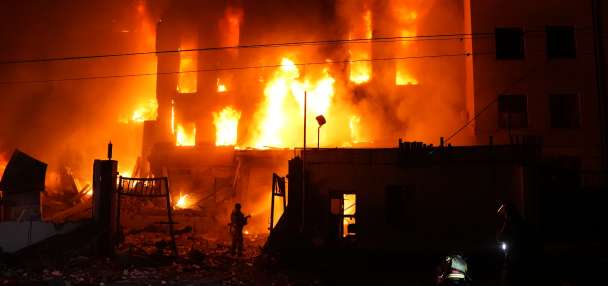
- Onslaught on Iran: Israel used more than 80 fighter jets in a "broad-scale wave of attacks" targeting military infrastructure in Iran early Saturday. Explosions were reported in the eastern and western parts of the capital, with dramatic footage showing Tehran's Mehrabad airport on fire. Iran's semi-official Mehr News Agency has accused Israel of striking the airport. CNN has reached out to the Israel Defense Forces for comment. The U.S. has struck more than 3,000 targets inside Iran in the past week, according to U.S. Central Command.
- Growing toll: So far, the US-Israel attacks have killed more than 1,230 people in Iran, including children, according to Iranian state media.
- Calls for new leader: Several prominent clerics in Iran have urged the swift election of a new Supreme Leader, one week after the killing of Ayatollah Ali Khamenei in US-Israeli strikes. Ayatollah Nasser Makarem Shirazi urged the country's Assembly of Experts to act quickly, saying Saturday: "The timely realization of this important matter will lead to national authority and the best possible organization of affairs."
- Chaos and fear: Iranian residents have described living in constant terror, with streets deserted as people hide at home or flee their villages. The fear is amplified by an internet blackout – leaving many with no access to news or warning systems before the bombs come.
- Strikes on Lebanon: Israel continued hitting Beirut on Friday, saying it targeted command centers used by the Iran-backed militant group Hezbollah. The strikes have killed more than 200 people and wounded nearly 800, according to Lebanese state media.
- UN peacekeepers: Two Ghanaian soldiers serving in the UN peacekeeping mission in Lebanon were "critically injured" after coming under missile fire on Friday, said the Ghanaian army. It did not specify whether the missiles were fired by Israel or Hezbollah.
- Mass displacement: Israel's far-reaching evacuation orders and strikes in Lebanon have displaced nearly half a million residents, the Norwegian Refugee Council estimated. Official figures suggest around 100,000 are in government shelters, but this is likely a fraction of the real figure.
What's happening in the rest of region?
- Gulf states under renewed attack: Saudi Arabia, Qatar, Bahrain and the UAE have seen fresh drone and missile attacks on Saturday. Dubai's international airport came under drone attack several times, with passengers reporting at least one impact and a number of interceptions. Qatar's Defense Ministry said a ballistic missile attack had been repelled, while sirens sounded in Bahrain, but there were no reports of impact. Saudi Arabia's Defense Ministry said 16 drones heading toward one of the largest oil fields in the Middle East, Shaybah, had been intercepted.
- Israel under fire: Iran and Lebanon are firing back at Israel with drones and missiles, with fragments falling in various parts of the country on Saturday. Israel repeatedly raised its air defenses and issued alerts to the public, instructing residents to shelter in a safe place. And on Friday, eight Israeli soldiers were wounded by Hezbollah fire, according to the Israel Defense Forces.
- Dubai flights resume: Flights to and from Dubai have resumed on Saturday after a brief suspension, with Dubai Airports saying this was "for the safety of passengers, airport staff, and airline crew." The Emirates airline has since said it will resume operations. Airports in the UAE are key nodes for connecting flights all over the world.
- Foreign investments reviewed: Some of Trump's oil-rich Gulf Arab allies are reviewing overseas investments as the war in Iran strains their economies, a Gulf official said, just months after the president secured trillions in investment pledges from the region. Saudi Arabia, the UAE and Qatar collectively pledged to invest around $3 trillion in the U.S. economy when Trump visited the region on his first foreign trip abroad last year. Any changes could put pressure on him to end the war.
- Kurdistan hotel: Hours after the U.S. Embassy in Baghdad warned Americans to leave Iraq, saying that hotels in Iraqi Kurdistan could be targeted by pro-Iranian militias, a drone exploded near a hotel in Erbil. A pro-Iranian Islamist militant group claimed responsibility, warning American troops and contractors that it would continue to target hotels across the country.
×
The Key Takeaways for this article were generated with the assistance of large language models and reviewed by our editorial team. The article, itself, is solely human-written.