'%3e%3cpath%20d='M34.1406%205.85938C30.3906%202.10547%2025.3047%200%2020%200C14.6953%200%209.60938%202.10547%205.85938%205.85938C2.10938%209.61328%200%2014.6953%200%2020C0%2025.3047%202.10547%2030.3906%205.85938%2034.1406C9.61328%2037.8906%2014.6953%2040%2020%2040C25.3047%2040%2030.3906%2037.8945%2034.1406%2034.1406C37.8906%2030.3906%2040%2025.3047%2040%2020C40%2014.6953%2037.8945%209.60938%2034.1406%205.85938ZM37.0117%2023.543H31.1602V13.5391H27.6328V19.9414C28.1211%2020.6914%2028.3711%2021.582%2028.3711%2022.5625V22.625C28.3711%2023.668%2028.1172%2024.6055%2027.6328%2025.4297V26.6094H36.082C33.4883%2032.9375%2027.2891%2037.3789%2020.0039%2037.3789C10.3711%2037.3789%202.62109%2029.6289%202.62109%2020C2.62109%2010.3711%2010.3711%202.62109%2020%202.62109C29.6289%202.62109%2037.3789%2010.3711%2037.3789%2020C37.3789%2021.1484%2037.2617%2022.2656%2037.0508%2023.3477C37.0391%2023.4141%2037.0234%2023.4766%2037.0117%2023.543Z'%20fill='white'/%3e%3cpath%20d='M22.3086%2018.5352C20.4336%2018.125%2019.9531%2017.8398%2019.9766%2017.1836V17.1406C19.9766%2016.6992%2020.3477%2016.2148%2021.4023%2016.2148C22.582%2016.2148%2023.8867%2016.6797%2025.0781%2017.4766L26.8516%2015.0195C25.4453%2013.8906%2023.707%2013.3398%2021.5547%2013.3398C18.5195%2013.3398%2016.4375%2015%2016.4063%2017.4766V17.5352C16.3633%2020.2617%2018.5859%2020.9805%2021.293%2021.6016C23.0391%2021.9766%2023.5703%2022.3164%2023.5703%2022.9609L23.5469%2022.9766C23.5469%2023.3906%2023.2578%2023.7031%2022.7852%2023.8359C22.5742%2023.9062%2022.1289%2023.9727%2021.5156%2023.9727C20.7617%2023.9727%2019.7539%2023.8633%2018.6328%2023.4844C18.0898%2023.2891%2017.4727%2023.0039%2016.8047%2022.6133L20.1406%2026.625C20.2813%2026.6602%2021.0977%2026.8516%2021.7734%2026.8516C25.0039%2026.8516%2027.0859%2025.2461%2027.1094%2022.6328V22.5703C27.1602%2020.1133%2025.2148%2019.1719%2022.3086%2018.5352Z'%20fill='white'/%3e%3cpath%20d='M5.24219%2013.5664V26.6133H8.75391V23.7578L10.2969%2021.9531L14.2031%2026.6133H18.3867L12.3555%2019.5195L17.4023%2013.5664H13.4531L8.75391%2019.0586V13.5664H5.24219Z'%20fill='white'/%3e%3c/g%3e%3cdefs%3e%3cclipPath%20id='clip0_97_2430'%3e%3crect%20width='40'%20height='40'%20fill='white'/%3e%3c/clipPath%3e%3c/defs%3e%3c/svg%3e)


Estimated read time: 3-4 minutes
This archived news story is available only for your personal, non-commercial use. Information in the story may be outdated or superseded by additional information. Reading or replaying the story in its archived form does not constitute a republication of the story.
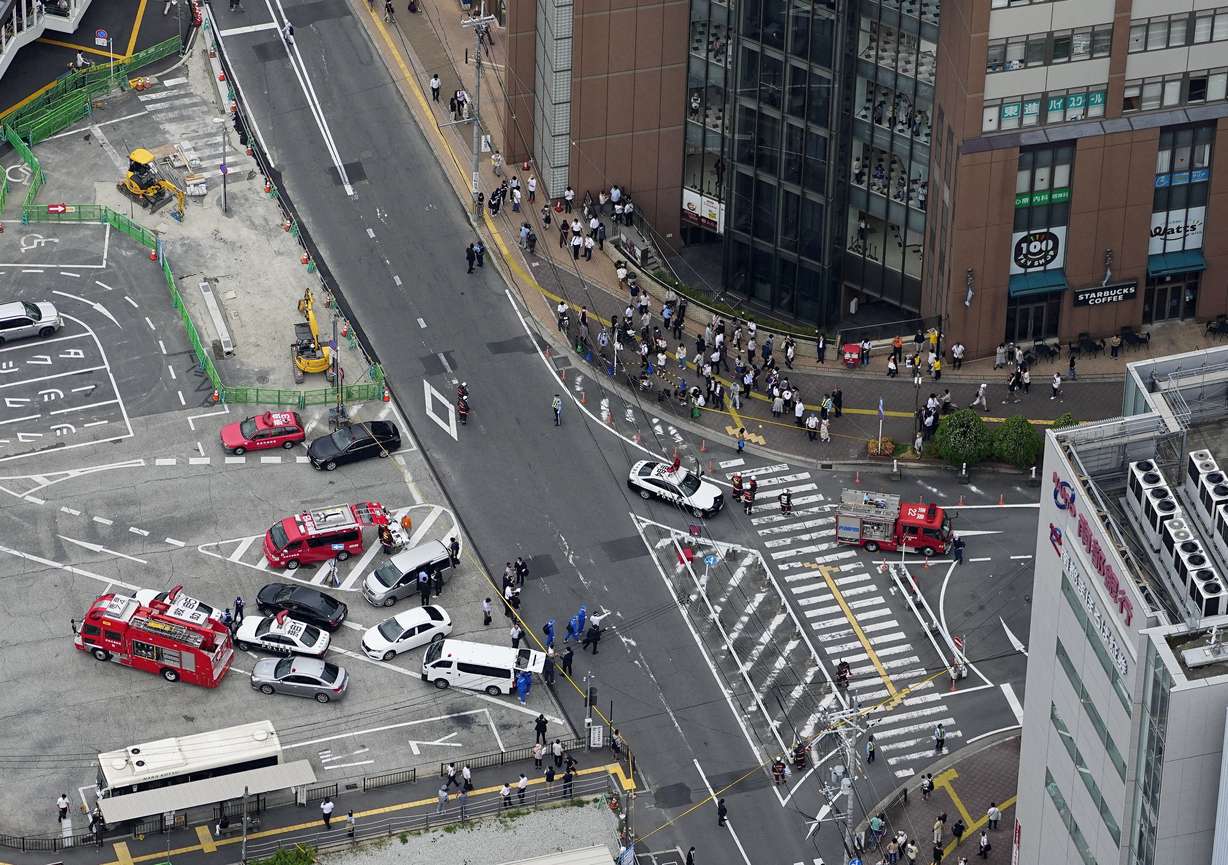
TOKYO — Japan's former Prime Minister Shinzo Abe was shot during a campaign speech Friday in western Japan and was airlifted to a hospital but he was not breathing and his heart had stopped, officials said.
Local fire department official Makoto Morimoto said Abe was in cardio and pulmonary arrest after being shot and was taken to a prefectural hospital.
Chief Cabinet Secretary Hirokazu Matsuno told reporters that police arrested an alleged male attacker at the scene. "A barbaric act like this is absolutely unforgivable, no matter what the reasons are, and we condemn it strongly," Matsuno said.
NHK public broadcaster aired footage showing Abe collapsed on the street, with several security guards running toward him, He was reportedly shot a few minutes after he started talking outside of a main train station in western Nara.
Prime Minister Fumio Kishida, who belongs to the same political party as Abe, is on his way to Tokyo on a helicopter from his own campaign destination of Yamagata, in northern Japan. Matsuno said all cabinet ministers are to return to Tokyo from their campaign trips.
In other footage, campaign officials were surrounding him to treat the popular former leader who is still influential in the governing Liberal Democratic Party and heads its largest faction Seiwakai. Elections for Japan's upper house, the less powerful chamber of its parliament, are set for Sunday.
Abe was giving a speech when people heard gunshots. He was holding his chest when he collapsed, his shirt smeared with blood, but he was able to speak before he fell unconscious.
The attack was a shock in a country that's one of the world's safest and with some of the strictest gun control laws in the world.
Abe stepped down in 2020 because he said a chronic health problem has resurfaced. Abe has had ulcerative colitis since he was a teenager and has said the condition was controlled with treatment.
He told reporters at the time that it was "gut wrenching" to leave many of his goals unfinished. He spoke of his failure to resolve the issue of Japanese abducted years ago by North Korea, a territorial dispute with Russia and a revision of Japan's war-renouncing constitution.
That last goal was a big reason he was such a divisive figure.
His ultra-nationalism riled the Koreas and China, and his push to normalize Japan's defensive posture angered many Japanese. Abe failed to achieve his cherished goal of formally rewriting the U.S.-drafted pacifist constitution due to poor public support.
Supporters of Abe said that his legacy was a stronger U.S.-Japan relationship that was meant to bolster Japan's defensive capability. But Abe made enemies too by forcing his defense goals and other contentious issues through parliament, despite strong public opposition.
Abe is a political blue blood who was groomed to follow in the footsteps of his grandfather, former Prime Minister Nobusuke Kishi. His political rhetoric often focused on making Japan a "normal" and "beautiful" nation with a stronger military and bigger role in international affairs.






