Estimated read time: 6-7 minutes
Rising prices are changing what it takes to retire comfortably today.
Here's what Utah families approaching retirement need to know.
If you're recently retired or planning to retire in the next few years, there's something important you need to consider: Retirement has become a lot more expensive.
Think about what you were paying for groceries five years ago. Or homeowners insurance. Health care. Eating out. Taking a vacation.
Now think about what you're paying for those same things today.
The difference is night and day.
And while rising prices are frustrating for everyone, they create an even bigger challenge for people who are retired or getting ready to retire.
Why?
Because when you're working, you have a paycheck coming in. You may get raises or promotions that help you keep up with the rising cost of living.
But once you retire, the paychecks stop. And suddenly, you're depending on the savings you've accumulated over a lifetime to pay for everything.
That's why the rising cost of retirement deserves a lot more attention than most people give it.
What most people don't realize about inflation
When you hear that inflation is coming down, that sounds like good news.
And it is. But there's a catch.
Lower inflation doesn't mean prices are going back down. It only means they're going up more slowly.
Think about that for a moment. The higher prices we're paying today are likely here to stay. And even if inflation settles down to a more normal level, prices will continue climbing in the years to come.
That's a serious consideration when you're planning for a retirement that could last 20 or 30 years.
Because the amount of money you need to retire comfortably today could be very different from what you'll need 10, 20 or 30 years from now.
What will your retirement really cost?
Let's put some numbers to this.
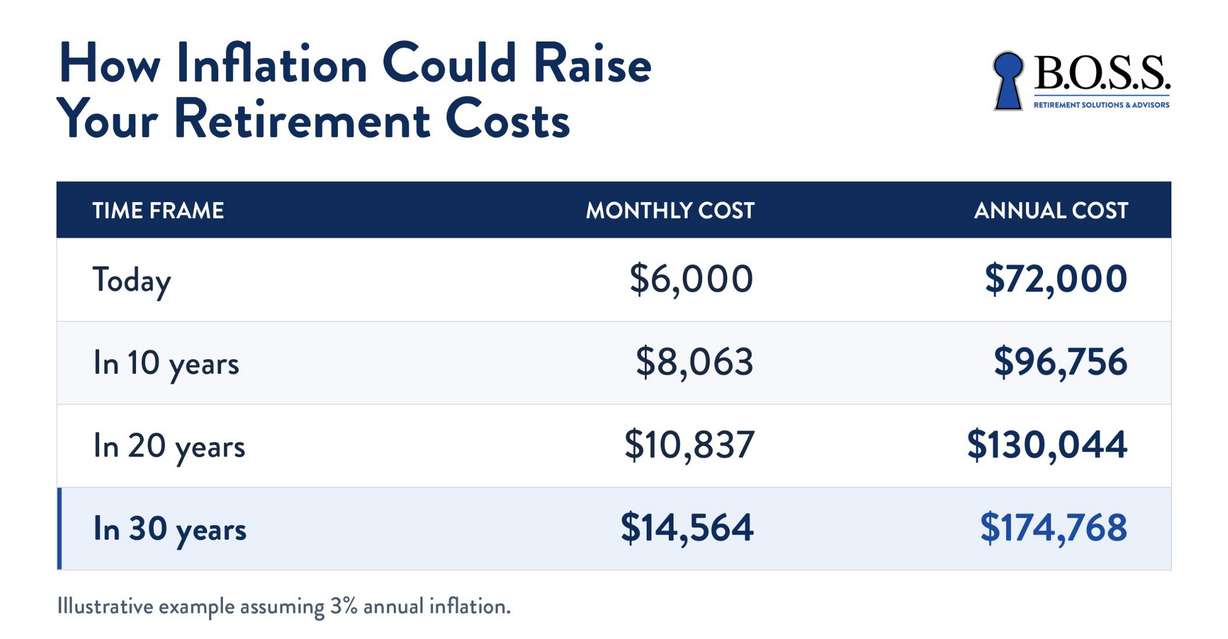
Suppose you've worked hard, saved diligently and determined that you'll need $6,000 a month to enjoy the retirement you've envisioned. That's $72,000 a year.
Maybe you've already built a retirement income plan around that number.
But here's the question: What happens when that $6,000-a-month lifestyle starts costing $8,000? Or $10,000? Or even more?
Assuming prices rise by an average of just 3% annually, here's what could happen to the cost of maintaining that same $6,000-a-month lifestyle:
These are hypothetical projections based on 3% annual inflation, not predictions of future inflation. But look closely at those numbers. In 20 years, you could need nearly $131,000 annually just to maintain the lifestyle that costs $72,000 today.
And in 30 years, the cost could more than double. Not because you're living extravagantly. Not because you're taking more vacations or buying more expensive things. Simply because everything costs more.
And this raises an important question: Is your retirement plan designed to provide the income you'll need in the future — or just the income you need today?
The hidden danger: Your savings could disappear faster than you planned
Here's where rising prices can become particularly troublesome for retirees.
When your expenses increase, you'll likely need to withdraw more money from your retirement accounts to pay your bills. And every additional dollar you withdraw is a dollar that's no longer invested and potentially growing for your future.
Over time, that could create a compounding problem.
But there's another complication. What happens if the stock market declines at the same time your living expenses are increasing?
You could find yourself withdrawing even more money from investments that have already lost value. And that combination can be particularly damaging during the early years of retirement.
In fact, Morningstar highlighted research showing that the timing of inflation can make a substantial difference in retirement planning. The research compared two retirees experiencing the same average inflation over 20 years. But the retiree who experienced higher inflation during the first five years of retirement would need almost 20% more in savings to fund the same lifestyle.
That's a significant difference. And it illustrates why inflation is not simply an inconvenience for retirees. It could change how long your savings will last.
The good news? There are ways to prepare
You can't control what groceries, health care, insurance or travel will cost in the future. And you certainly can't control what the stock market will do.
But that doesn't mean you're powerless.
There are financial planning strategies designed to help address rising expenses, protect your purchasing power and make your retirement savings last longer.
The key is to consider these issues before they become a problem.
For example, does your retirement income plan account for expenses that will likely increase substantially over time?
Are your investments positioned to provide an appropriate balance between protecting your savings and allowing them to grow?
And do you have enough flexibility in your retirement income plan to avoid selling investments at the wrong time?
These are important questions. And the answers could make a meaningful difference in your retirement.
There are financial planning strategies designed to help address rising expenses, protect your purchasing power and make your retirement savings last longer.
–Tyson Thacker, B.O.S.S. Retirement Solutions
Free report: 'The New Price of Retiring Today'
To help Utah families better understand these challenges, retirement planning professionals Tyson Thacker and Ryan Thacker, founders of B.O.S.S. Retirement Solutions, have prepared a free educational report: "The New Price of Retiring Today: How to Make Your Money Last in a More Expensive World."
Inside this free report, you'll discover:
- Why today's higher prices are likely here to stay — and what that could mean for your retirement.
- How rising expenses could quietly drain your retirement savings faster than you planned.
- Strategies that could help your money keep pace with rising prices and last throughout retirement.
Whether you're already retired or planning to retire in the next few years, understanding how rising costs could impact your savings can help you answer two critical questions: How long could your money last, and what could you do to help it last longer?
Download your free report here
B.O.S.S. Retirement Solutions has helped tens of thousands of families make more informed decisions on Social Security. It is a multi-time winner of Utah's Best of State award and are frequently featured on NBC, CBS and ABC TV and on local radio stations.
About the authors: Tyson Thacker and Ryan Thacker are the founders of B.O.S.S. Retirement Solutions. They are published authors of the Amazon best-selling book "The B.O.S.S. Retirement Blueprint, Your Guide to a Secure and Independent Retirement." Their award-winning firm has seven offices located throughout the Wasatch Front and a new office in St. George.
Investment advisory services offered through B.O.S.S. Retirement Advisors, an SEC-registered investment adviser. Insurance products and services offered through B.O.S.S. Retirement Solutions. Information contained in this material is for informational purposes only. Actual results may vary. No statement contained herein shall constitute tax, legal or investment advice. The information is not intended to be used as the sole basis for financial decisions, nor should it be construed as advice designed to meet the particular needs of any individual. You should seek advice on legal and tax questions from an independent attorney or tax adviser. Our firm is not affiliated with the Social Security Administration, U.S. government or any governmental agency.