'%3e%3cpath%20d='M34.1406%205.85938C30.3906%202.10547%2025.3047%200%2020%200C14.6953%200%209.60938%202.10547%205.85938%205.85938C2.10938%209.61328%200%2014.6953%200%2020C0%2025.3047%202.10547%2030.3906%205.85938%2034.1406C9.61328%2037.8906%2014.6953%2040%2020%2040C25.3047%2040%2030.3906%2037.8945%2034.1406%2034.1406C37.8906%2030.3906%2040%2025.3047%2040%2020C40%2014.6953%2037.8945%209.60938%2034.1406%205.85938ZM37.0117%2023.543H31.1602V13.5391H27.6328V19.9414C28.1211%2020.6914%2028.3711%2021.582%2028.3711%2022.5625V22.625C28.3711%2023.668%2028.1172%2024.6055%2027.6328%2025.4297V26.6094H36.082C33.4883%2032.9375%2027.2891%2037.3789%2020.0039%2037.3789C10.3711%2037.3789%202.62109%2029.6289%202.62109%2020C2.62109%2010.3711%2010.3711%202.62109%2020%202.62109C29.6289%202.62109%2037.3789%2010.3711%2037.3789%2020C37.3789%2021.1484%2037.2617%2022.2656%2037.0508%2023.3477C37.0391%2023.4141%2037.0234%2023.4766%2037.0117%2023.543Z'%20fill='white'/%3e%3cpath%20d='M22.3086%2018.5352C20.4336%2018.125%2019.9531%2017.8398%2019.9766%2017.1836V17.1406C19.9766%2016.6992%2020.3477%2016.2148%2021.4023%2016.2148C22.582%2016.2148%2023.8867%2016.6797%2025.0781%2017.4766L26.8516%2015.0195C25.4453%2013.8906%2023.707%2013.3398%2021.5547%2013.3398C18.5195%2013.3398%2016.4375%2015%2016.4063%2017.4766V17.5352C16.3633%2020.2617%2018.5859%2020.9805%2021.293%2021.6016C23.0391%2021.9766%2023.5703%2022.3164%2023.5703%2022.9609L23.5469%2022.9766C23.5469%2023.3906%2023.2578%2023.7031%2022.7852%2023.8359C22.5742%2023.9062%2022.1289%2023.9727%2021.5156%2023.9727C20.7617%2023.9727%2019.7539%2023.8633%2018.6328%2023.4844C18.0898%2023.2891%2017.4727%2023.0039%2016.8047%2022.6133L20.1406%2026.625C20.2813%2026.6602%2021.0977%2026.8516%2021.7734%2026.8516C25.0039%2026.8516%2027.0859%2025.2461%2027.1094%2022.6328V22.5703C27.1602%2020.1133%2025.2148%2019.1719%2022.3086%2018.5352Z'%20fill='white'/%3e%3cpath%20d='M5.24219%2013.5664V26.6133H8.75391V23.7578L10.2969%2021.9531L14.2031%2026.6133H18.3867L12.3555%2019.5195L17.4023%2013.5664H13.4531L8.75391%2019.0586V13.5664H5.24219Z'%20fill='white'/%3e%3c/g%3e%3cdefs%3e%3cclipPath%20id='clip0_97_2430'%3e%3crect%20width='40'%20height='40'%20fill='white'/%3e%3c/clipPath%3e%3c/defs%3e%3c/svg%3e)


Estimated read time: 6-7 minutes
Sleep is often treated like a luxury.
Something people sacrifice to work more, worry more, scroll more, care for others, or simply keep up with life. But sleep is not optional. It is one of the brain's most important maintenance systems.
During healthy sleep, the brain repairs, resets, organizes memories, regulates emotion, clears metabolic waste, and restores the neural systems needed for attention, communication, and clear thinking. When sleep is disrupted night after night, the brain does not fully recover. It carries yesterday's stress into today.
That matters for memory. It matters for mood. It matters for focus.
And it also matters for hearing and tinnitus.
If you're experiencing poor sleep, ringing in your ears, difficulty hearing conversations, or concerns about memory, don't ignore the connection.
Learn how these conditions affect brain health by visiting BrainCareHealth.com or call (435) 253-6243 to speak with a brain health specialist.
Most adults recognize the obvious effects of poor sleep: fatigue, irritability, slower thinking and reduced patience. Far fewer realize that chronic sleep disruption can also affect the ear-to-brain pathways responsible for hearing clarity, listening effort, sound filtering and tinnitus control.
The hearing system is not separate from the sleeping brain. Hearing depends on precise neural timing, stable attention, efficient energy use, and the brain's ability to filter meaningful sound from background noise. Poor sleep weakens each of these systems.
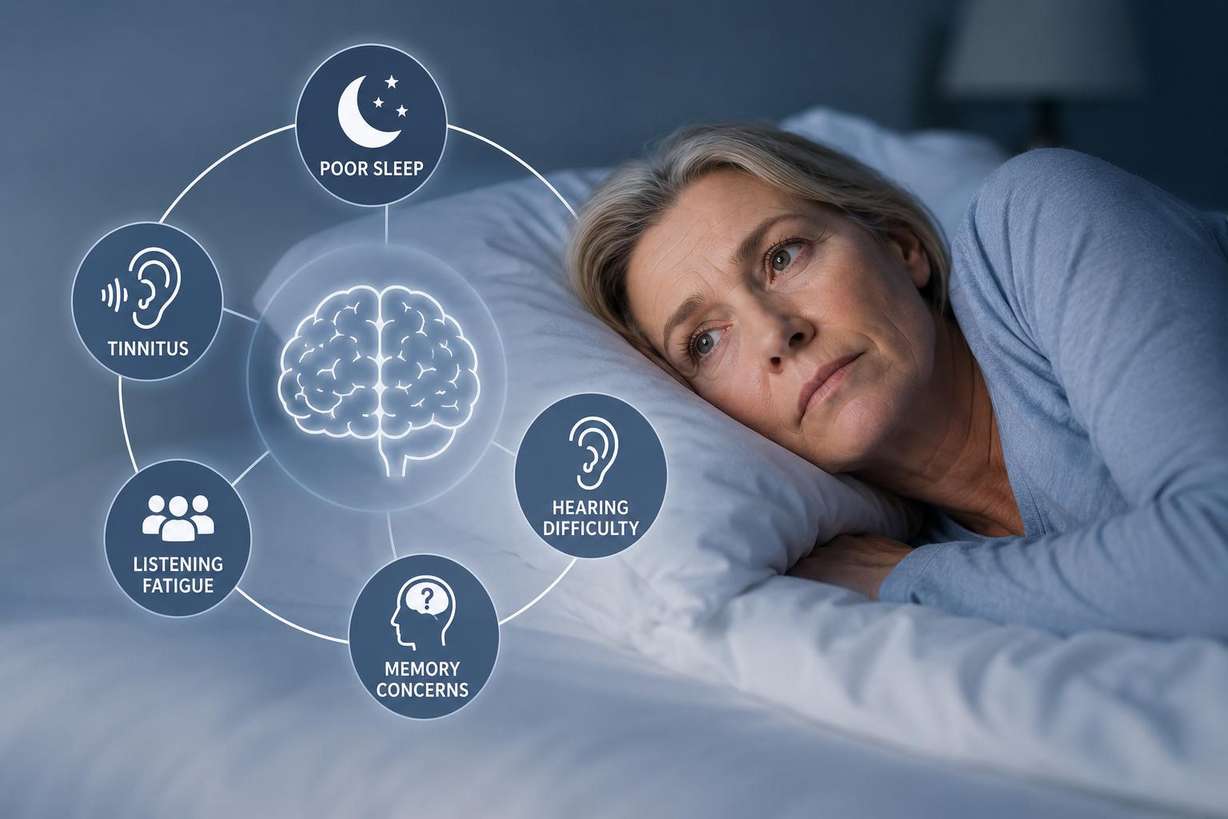
That is why many adults with chronic sleep problems notice more difficulty hearing in background noise. They may struggle in restaurants, meetings, or group conversations. They may feel mentally drained after listening. They may also notice ringing, buzzing, humming, or hissing in the ears, especially at night when the world becomes quiet.
These symptoms are often dismissed as stress or normal aging. But for many adults, they may be signs that the brain is running without enough recovery.
Sleep disorders include more than sleep apnea. They also include chronic insomnia, frequent awakenings, poor sleep quality, irregular sleep timing, and not getting enough restorative sleep. A person may spend enough hours in bed but still fail to reach the deep, organized sleep cycles the brain needs.
During sleep, the brain strengthens important connections, prunes unnecessary ones, regulates inflammation, balances stress hormones, and supports memory formation. Sleep also helps the brain clear waste products that accumulate during waking hours. When sleep is shortened or fragmented, these processes are interrupted.
Over time, the brain becomes less efficient.
Tinnitus creates an internal sound that competes with the outside world. For some, it is a mild background sound. For others, it is constant and intrusive. Ringing, buzzing, humming, or hissing can pull attention away from conversations during the day and become especially noticeable at night.
This is where the cycle becomes cruel.
Poor sleep makes the brain more reactive to tinnitus. Tinnitus makes it harder to fall asleep or stay asleep. The next day, fatigue makes tinnitus feel louder, listening feels harder, and stress increases. That stress can disrupt sleep again.
Night after night, the loop continues.
Many people assume these symptoms are simply part of getting older, but they may be signs that your brain needs support.
Visit BrainCareHealth.com to learn about the relationship between hearing, tinnitus, sleep, and cognitive health, or call (435) 253-6243 to schedule a consultation.
Loved ones may not recognize what is happening. A person who is sleep deprived, struggling to hear, and distracted by tinnitus may seem withdrawn, irritable, forgetful, or disconnected. They may avoid restaurants, meetings, phone calls, or family gatherings because listening now feels like work.
These changes are often misread as mood problems, disinterest, or early memory loss. In reality, the brain may be overloaded, under-rested, and working too hard to communicate.
This is why hearing loss and tinnitus are not minor inconveniences, especially in adults with sleep disorders. They add strain to a nervous system that is already struggling to recover.
Modern neuroscience makes the connection clear: sleep health, hearing health, tinnitus, and cognitive health are deeply intertwined.
The brain needs sleep to maintain efficient energy use, stable neural communication, inflammation control, and accurate sensory processing. Chronic sleep disruption undermines each of these. It can increase neuroinflammation, impair glucose metabolism in brain cells, alter blood-flow regulation, and reduce the brain's ability to repair itself.
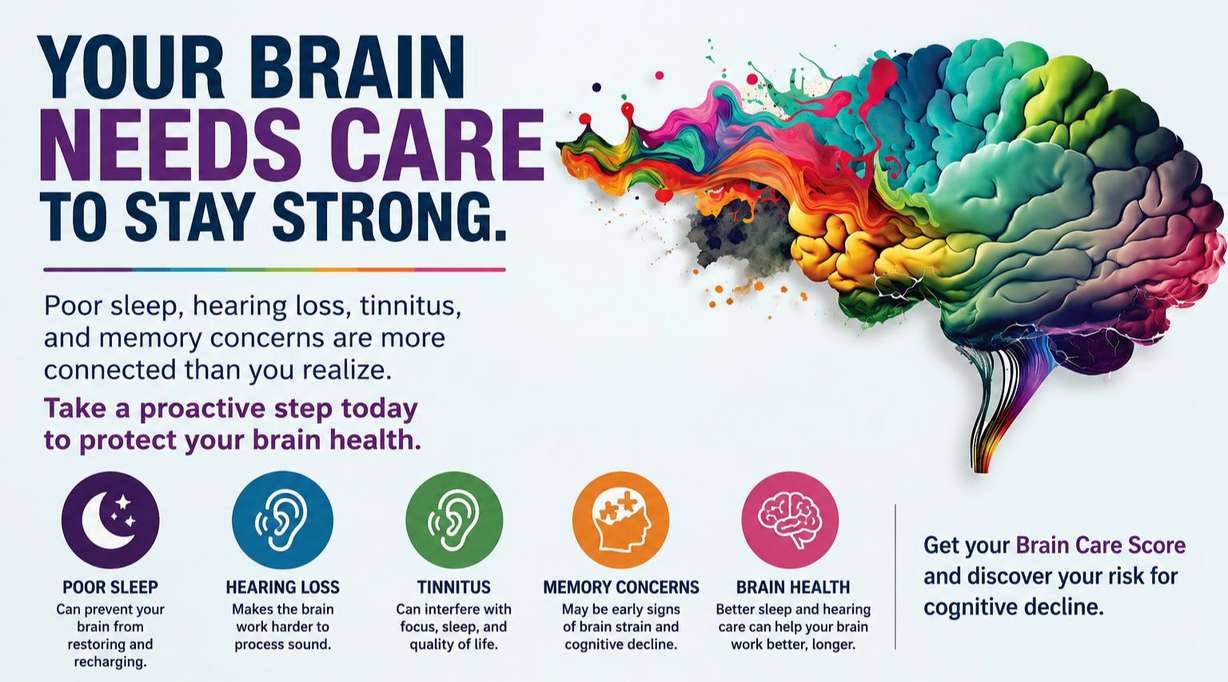
At the same time, hearing loss and tinnitus increase the brain's workload.
This combination is especially concerning for long-term cognitive health. The brain has a protective buffer known as cognitive reserve. It helps us stay mentally sharp despite aging, stress, and disease. But cognitive reserve is not unlimited.
When too much of that reserve is spent trying to hear, suppress background noise, manage tinnitus, and push through fatigue, less is available for memory, focus, decision-making and resilience against decline.
Poor sleep also affects the brain's waste-clearance systems. During restorative sleep, the brain clears metabolic byproducts that build up during waking hours. When sleep is repeatedly disrupted, those cleanup systems are less effective. Over time, this may increase vulnerability to cognitive decline and dementia.
This is why sleep problems should not be brushed aside as just part of modern life.
And hearing difficulty should not be ignored simply because it seems mild.
For many adults, trouble hearing in noise, listening fatigue and tinnitus may appear years before memory problems become obvious. These symptoms may be early signs that the brain is under strain and no longer recovering the way it should.
The good news is that sleep disorders, hearing loss, tinnitus and many dementia risk factors are modifiable.
You cannot change your age or genetics. But you can improve sleep routines. You can address insomnia. You can be evaluated for sleep apnea. You can manage stress. You can reduce nighttime disruption. You can treat hearing loss. And you can treat tinnitus.
That is why hearing care belongs in the conversation about sleep and brain health.
Treating hearing loss is not simply about making sounds louder. Proper prescription hearing treatment improves the quality and stability of sound reaching the brain. When auditory input becomes clearer, the brain does not have to work as hard to follow conversations, especially when tired or in background noise.
Tinnitus care also matters. Effective tinnitus treatment can reduce distress, calm the nervous system, improve sleep quality, and free cognitive resources for focus, memory, and emotional regulation.
For adults with chronic sleep disruption, this can be life-changing.
If poor sleep, hearing difficulty, tinnitus, or memory concerns are affecting your daily life, now is the time to take action.
Visit BrainCareHealth.com to learn more about protecting your cognitive health and discover how hearing and brain care work together. Or call (435) 253-6243 to schedule your consultation and take the first step toward better brain health.