Estimated read time: 5-6 minutes
This archived news story is available only for your personal, non-commercial use. Information in the story may be outdated or superseded by additional information. Reading or replaying the story in its archived form does not constitute a republication of the story.
SALT LAKE CITY — The Oxford English Dictionary defines cyborg as “a fictional or hypothetical person whose physical abilities are extended beyond normal human limitations by mechanical elements built into the body.”
While most don't yet have any technology built into their body, almost everyone is constantly connected to their smartphone, tablet or laptop and fully reliant on the technology in their hands, on their desks or in their dashboards. Some even call it their "second brain."
To leaders in the tech industry, the cyborg world draws ever closer. In fact, technology implants may not be as far-fetched as they seem.
Seattle-based company Dangerous Things is dedicated to “custom gadgetry for the discerning biohacker," or someone who puts technology into their body for a wide variety of reasons. Dangerous Things advertises chips planted under the skin that allow users to unlock doors, cars, laptops and more.
Amal Graafstra, the founder of Dangerous Things, has also since founded VivoKey, a company that wants to merge digital footprints and medical and financial info into a wearable chip for much the same reason many use phones or smartwatches to pay for things now.
Ray Kurzweil, author, scientist and futurist, believes humans will be able to connect the neocortex of the brain to the cloud or internet by the 2030s. He recently outlined his predictions for the next 25 years during a keynote speech at Singularity University.
Kurzweil founded Singularity University in response to an essay by Vernor Vinge, the sci-fi author who created the idea of cyberspace. "Singularity" happens when artificial intelligence and biohacking reach the point of transcending our present forms. We will then be “funnier, sexier and more loving,” according to an interview with Kurzweil in the Huffington Post.
Related Stories:
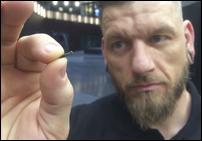
Cyborgs at work: employees getting implanted with microchips
The syringe slides in between the thumb and index finger. Then, with a click, a microchip is injected in the employee's hand. Another "cyborg" is created.Unlike the injectable chip under the skin, Kurzweil sees connectivity happening through nanotechnology. And he's not alone.
Nicholas Negroponte, founder of MIT’s Media Lab, doesn’t like to make predictions but told BigThink.com that he fully believes nanobots will be part of the future. James Friend, a professor of mechanical engineering with an emphasis on medical nanotechnology at UC San Diego, told ABC.net.au that microbots could be injected into brains to help with epilepsy and other medical conditions.
Elon Musk, entrepreneur and CEO of SpaceX and Tesla, believes humans risk becoming “irrelevant” in light of artificial intelligence unless they can communicate directly with machines, according to a report by The Verge.
To this end, Musk is backing a brain-computer interface venture called Neuralink to plant tiny electrodes in brains, according to the Wall Street Journal. The company has no public presence as of yet, but Musk hints it isn’t long until a “neural lace” is created, or an interface between brain and computer.
Bryan Johnson, an entrepreneur born in Provo and currently living in Los Angeles, also founded a start-up called Kernel that seeks to use neural interfaces to treat disease and help cognition. Johnson acknowledges Musk’s work with Neuralink and his own desire to hack the brain in a report by The Verge.
“Brain science is the new rocket science,” Johnson said.
Unlike the injectable chip under the skin, Kurzweil sees connectivity happening through nanotechnology. And he's not alone.
Nicholas Negroponte, founder of MIT’s Media Lab, doesn’t like to make predictions but told BigThink.com that he fully believes nanobots will be part of the future. James Friend, a professor of mechanical engineering with an emphasis on medical nanotechnology at UC San Diego, told ABC.net.au that microbots could be injected into brains to help with epilepsy and other medical conditions.
Elon Musk, entrepreneur and CEO of SpaceX and Tesla, believes humans risk becoming “irrelevant” in light of artificial intelligence unless they can communicate directly with machines, according to a report by The Verge.
To this end, Musk is backing a brain-computer interface venture called Neuralink to plant tiny electrodes in brains, according to the Wall Street Journal. The company has no public presence as of yet, but Musk hints it isn’t long until a “neural lace” is created, or an interface between brain and computer.
Bryan Johnson, an entrepreneur born in Provo and currently living in Los Angeles, also founded a start-up called Kernel that seeks to use neural interfaces to treat disease and help cognition. Johnson acknowledges Musk’s work with Neuralink and his own desire to hack the brain in a report by The Verge.
“Brain science is the new rocket science,” Johnson said.