
Estimated read time: 2-3 minutes
This archived news story is available only for your personal, non-commercial use. Information in the story may be outdated or superseded by additional information. Reading or replaying the story in its archived form does not constitute a republication of the story.
SALT LAKE COUNTY -- Losing track of a child or an elderly loved one who tends to wander can be a frightening experience. There are products out there to help caregivers, but do police think they're a good investment?
94% of Alzheimer's wanderers are found within 1.5 miles of where they were last seen. -Alzheimer's Association
Shana Davis is a busy mom to 8-year-old triplets. Bennett, who's autistic, is one of them.
"He has a tendency to wander," Davis said. "He's very impulsive."
And, she says, that's led to a few scares.
"I can't tell you how many times I've had that sick feeling and I'm going, 'Where's Bennett? Where's Bennett?' and I'm calling through the neighborhood," she said. "And a neighbor across the street, she said, 'Oh, he's here, he's at my house, he's playing inside.'"
But these days, Davis says she has some peace of mind. She bought a SecuraTrac, a small GPS device that allows her to keep track of her son.
She goes online to install invisible fences around various places, like her yard. If Bennett crosses the fence, she'll get an e-mail or text message on her phone, telling her where he is.
It also has an S.O.S. button he can push if he's in trouble.
"I think anything that can assist in finding somebody that happens to wander is a very good idea," said Lt. Don Hutson with the Unified Police Department.
Unified police recently began using a similar device, called the LoJack SafetyNet System, for rescues.
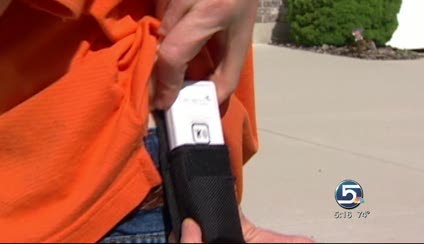
A transmitter, which is available for purchase, emits a radio frequency signal. Unified police, which partnered with Project Lifesaver, has a receiver that can track the frequency within a mile.
Hutson showed KSL how the device works. He wore the transmitter and hid outside.
Capt. Teri Sommers used the receiver to find a signal. As she headed north, the signal got stronger.
In a recent National Autism Association online survey, 92% of respondents said their autistic child was at risk of wandering.
"This is showing that I'm probably 99 percent in this direction and how fast that beep is coming," said Sommers. "And there's Don right there."
Police say there are several devices like this available for a price and a monthly service fee. Shana Davis says it's worth it.
"This is going to provide a bunch of relief for me," she said.
There are other similar devices available, and police say you should compare them to see which is best for you.
E-mail: syi@ksl.com